
A global compilation of the neodymium isotopic composition of seawater for GEOTRACES
GEOTRACES will allow the collection of numerous data that will be archived in the GEOTRACES Data Assembly Centre (GDAC), and will eventually contribute to create a world atlas of tracers in the ocean. However, data acquired on GEOTRACES core parameters in the framework of past cruises could also be considered in this gathering. With this aim, François Lacan and co-authors (Lacan at al, 2012) propose a commented compilation of the neodymium (Nd) isotope and concentration data published before September 1st, 2011. A very interesting tool for modellers and any other scientist following works on this tracer!
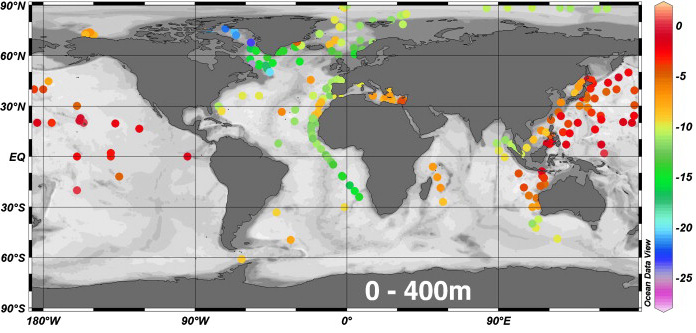
Figure: εNd averaged between the surface and 400 m depth. Figure made with Ocean Data View (Schlitzer, 2009).
Source: Author manuscript, definitive and authenticated version published in “Chemical Geology 300-301 (2012) 177-184″
References:
Lacan F., Tachikawa K., Jeandel C. (2012) Neodymium isotopic composition of the oceans: A compilation of seawater data Chemical Geology, Volume: 300-301 DOI : 10.1016/j.chemgeo.2012.01.019. Click here to acces the author’s manuscript.
Schlitzer R. (2009) Ocean data view, http://odv.awi.de