Impressive set of data reveal new features on the modern cadmium–phosphate relationship
Xie and co-authors (2015, see reference below) report vertical profiles of dissolved cadmium (Cd) in the western South Atlantic Ocean (GEOTRACES section GA02), which show nutrient-like distributions similar to those of the macronutrient phosphate (PO4). A close look at the data reveal:
- In the surface ocean, preferential uptake of Cd over PO4 by phytoplankton occurs along the transect, regardless of ambient iron (Fe) concentrations, suggesting Fe availability is not critical for biological Cd utilization in the southwest Atlantic;
- In addition, horizontal advection of Cd-depleted low oxygen waters originating from the Angola Basin and brought across the Atlantic Ocean via the Benguela and Equatorial currents imparts a Cd-depleted signature to equatorial intermediate waters distinguishing them from southerly intermediate waters.
- This new dataset provides further evidence that Subantarctic Mode Water plays an important role in generating the non-linearity of the global Cd-PO4 correlation.
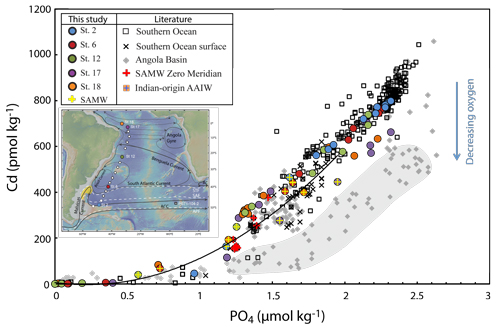
Figure: Evaluation of Cd–PO4 systematics using new data from GEOTRACES GA02 Leg 3 (colored circles; see inset for location) and literature data (Southern Ocean: Abouchami et al., 2014; Baars et al., 2014; Boyé et al., 2012; Xue et al., 2013; Indian Ocean: Vu and Sohrin, 2013; Angola Basin: Waeles et al., 2013) at the scale of the South Atlantic Basin. The Cd–PO4 relationship for samples with PO4 >1.3 μmol kg-1 in this study exhibits two parallel linear correlations. The influence of low-oxygen waters originating in the Angola Basin (grey shading) is noticeable in intermediate waters at the equatorial stations. The clear kink at PO4 ~ 1.3 μmol kg-1 in the South Atlantic is attributed to northward flowing, nutrient-rich Subantarctic Mode Water. Click here to view the figure larger.
Reference:
Xie, R. C., Galer, S. J. G., Abouchami, W., Rijkenberg, M. J. A., De Jong, J., de Baar, H. J. W., & Andreae, M. O. (2015). The cadmium–phosphate relationship in the western South Atlantic — The importance of mode and intermediate waters on the global systematics. Marine Chemistry, 177, 110–123. doi:10.1016/j.marchem.2015.06.011