Coupling Rare Earth Elements concentrations, neodymium and radium isotopes: a powerful tool to decode environmental processes
For the first time, neodymium (Nd) isotopic compositions have been measured together with dissolved and colloidal Rare Earth Elements (REE) concentrations in the Amazon estuary salinity gradient, as part of the GEOTRACES process study AMANDES (Chief scientist: Catherine Jeandel). The sharp drop of REE concentrations in the low-salinity area (already observed in several estuaries) is clearly driven by the coagulation of colloidal material. While dissolved REE concentrations are increasing again at mid-salinities, Nd isotopic ratios allow tracing that these REE are released by the lithogenic material, weathered and transported by the river to the Atlantic Ocean. The original coupling with the radium (Ra) isotopes demonstrates that these dissolution processes are occurring within three weeks in the Amazon plume.
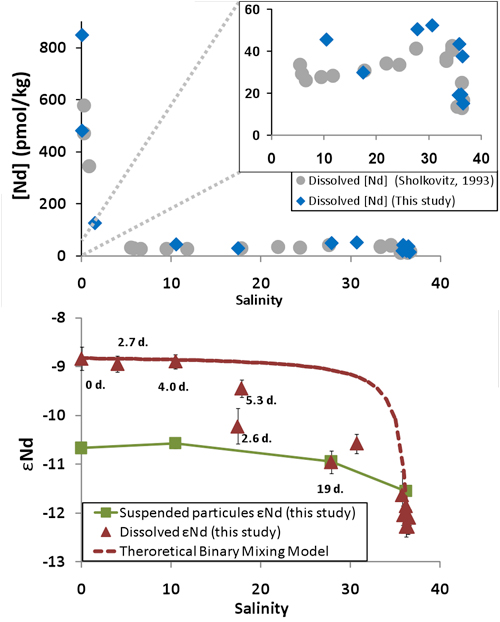
Figure: Nd concentrations and isotopic composition in the Amazon River estuary. Click here to view the image larger.
Upper panel: Amazon estuary [Nd] from Sholkovitz’ 1993 study (grey circles) and this study (Blue diamonds) are reported against the salinity gradient. We observe the non conservative mixing between the Amazon river and the Atlantic waters. The sharp drop in [Nd] in the low salinity region is attributed to the coagulation of colloids, the main REE carriers within river. This drop in concentrations is followed by an increase with salinity before reaching typical low Nd levels of marine waters.
Lower panel: Amazon estuary dissolved (Red triangles), particulate (Green squares) εNd and apparent radium ages (in days) values are reported against the salinity gradient. A simple two-endmembers (Amazon and Atlantic dissolved Nd) mixing model (red dashed line) is not sufficient to explain εNd variation within the salinity gradient. The dissolved Nd phase rapidly (19 days) homogeneizes with a third source the suspended sediments.
Reference:
Rousseau, T. C. C., Sonke, J. E., Chmeleff, J., Beek, P. van, Souhaut, M., Boaventura, G., Seyler, P., Jeandel, C. (2015). Rapid neodymium release to marine waters from lithogenic sediments in the Amazon estuary. Nature Communications, 6, 7592. doi:10.1038/ncomms8592. Click here to access the paper.