
Neodymium isotopic signature of the Ross Sea Water characterized
The first seawater neodymium isotopic compositions (εNd) and neodymium concentrations [Nd] profiles across the South Pacific circum-Antarctic fronts have been published recently (Basak et al., 2015, see reference below). Thanks to this exceptional GEOTRACES-compliant data, collected on R/V Polarstern cruise PS75, authors characterize the εNd signature of Ross Sea Bottom Water (εNd ~ -7) and show that meridional Nd concentrations changes follow the density structure of the South Pacific. The latter suggests a lateral transport component for the processes controlling Nd concentrations in the Southern Ocean rather than vertical processes.
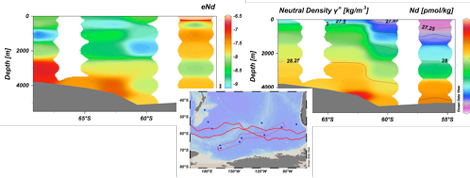
Figure: Distribution of εNd and [Nd] across the South Pacific frontal system (map) from the Ross Sea into the southeast Pacific. Left: Distribution of dissolved εNd; right: Distribution of [Nd] with neutral density contours. Click on the following links to view the figures larger: map, distribution of dissolved εNd and distribution of [Nd].
Reference:
Basak, C., Pahnke, K., Frank, M., Lamy, F., & Gersonde, R. (2015). Neodymium isotopic characterization of Ross Sea Bottom Water and its advection through the southern South Pacific. Earth and Planetary Science Letters, 419, 211–221. doi:10.1016/j.epsl.2015.03.011