
Insights into Particle Cycling from Thorium and Particle Data
Phoebe Lam and Olivier Marchal (2015, see reference below) propose to describe, with the same model, the dynamics of particles in the oceanic water column and its effects –on four different tracers characterized by very distinct sources and sinks. The considered tracers are: Particulate Organic Carbon (POC) (a biogenic compound), barium (Ba) (an authigenic mineral), titanium (Ti) (mainly lithogenic), and thorium isotopes (a particle-reactive radionuclide). Thorium isotopes are used for the estimation of exchange rates between small and large particles and for the estimation of particle settling velocities. Lessons learned from thorium isotopes may be applied to understand other classes of particle tracers such as POC, Ba, and Ti.
Main results:
- The separation of oceanic particles in two distinct classes (small, suspended particles and large, sinking particles), which interact throughout the water column via aggregation and disaggregation processes, remains a useful description of particle cycling, provided its limitations are fully appreciated.
- The simple models currently used in marine particle research (small particles are suspended and interact with seawater, large particles are removed by sinking, small and large particles interact throughout the water column, …) allow one to reproduce the observed vertical distributions of a range of chemical substances in the ocean, such as POC, Ba, Ti, and 230Th, in spite of their distinct sources and sinks as well as reactivities.
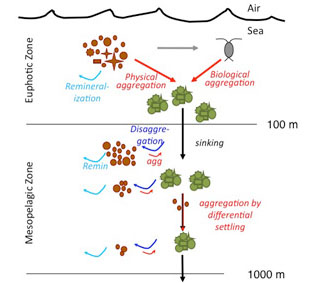
Figure: Schematic depiction of the biological carbon pump, emphasizing the important particle dynamics processes: aggregation (red arrows ), sinking (black arrows), disaggregation (dark blue arrows), and remineralization (light blue arrows). Particles in the small, suspended size fraction (brown) comprise phytoplankton, authigenic particles, and lithogenic particles and do not sink or sink very slowly. Particles in the large, sinking size fraction (green) comprise fecal material and aggregates of smaller particles and do sink. Aggregation can be abiotic or mediated by zooplankton packaging through fecal pellet production. Click here to view the figure larger.
Reference :
Lam, P. J., & Marchal, O. (2015). Insights into Particle Cycling from Thorium and Particle Data. Annual Review of Marine Science, 7, 159–184. doi:10.1146/annurev-marine-010814-015623 Click here to access the paper.