
Unprecedented set of dissolved manganese data in the North Atlantic Ocean (US GEOTRACES cruise)
Manganese (Mn) is an essential nutrient for biological growth. In the ocean, manganese distribution is sensitive to several processes: redox conditions, photochemistry, biological activity, abiotic scavenging, and also eolian, hydrothermal and sedimentary sources. All of them are conditioning the concentration of dissolved Mn in the ocean vertical profiles as shown in the east-west ocean section proposed by Wu and co-workers across the Subtropical North Atlantic Ocean (see figure below).
Their simple model calculation suggests that the main actors determining the distribution are:
- In the surface waters (0-40m): eolian Mn(II) deposition and in-situ photochemical reduction of dioxide of manganese (MnO2).
- Below the mixed layer (40-200m): the intensity of sunlight available for in-situ MnO2 photochemical reduction.
- Between 200 and 700 m: regeneration preformed Mn in the source water and lateral inputs from hydrothermal and sedimentary sources.
- Below 700 m: lateral inputs from hydrothermal and sedimentary sources become predominant.
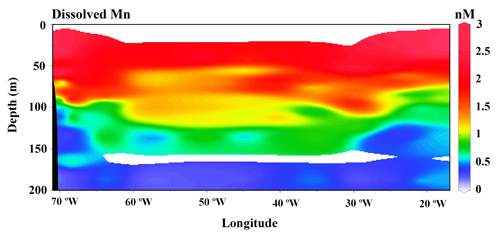
Figure. Vertical distribution of manganese (Mn) along a section across Subtropical North Atlantic. Warm colours (red, orange, etc.) indicate high concentrations. Click here to view the figure larger.
Reference:
Wu, J., Roshan, S., & Chen, G. (2014). The distribution of dissolved manganese in the tropical–subtropical North Atlantic during US GEOTRACES 2010 and 2011 cruises. Marine Chemistry, 166, 9–24. doi:10.1016/j.marchem.2014.08.007. Click here to access the paper.