
The distribution of dissolved iron in the West Atlantic Ocean
Iron (Fe) is an essential trace element for marine life. Extremely low Fe concentrations limit primary production and nitrogen fixation in large parts of the oceans and consequently influence ocean ecosystem functioning. In a publication published on 30 June in Plos ONE, Rijkenberg and co-authors present dissolved Fe (DFe) values measured at an unprecedented high intensity (1407 samples) along the longest full ocean depth transect (17500 kilometers) covering the entire western Atlantic Ocean.
DFe measurements along this transect revealed details about the supply and cycling of Fe. External sources of Fe identified included off-shelf and river supply, hydrothermal vents and aeolian dust. Nevertheless, vertical processes, such as the recycling of Fe resulting from the remineralization of sinking organic matter and the removal of Fe by scavenging, dominated the distribution of DFe. Iron recycling and lateral transport of DFe from the eastern tropical North Atlantic Oxygen Minimum Zone (OMZ) were important sources of DFe to the northern West Atlantic Ocean.
Finally, this study showed that the North Atlantic Deep Water (NADW), the major driver of the so-called oceanic conveyor belt, contains excess DFe relative to phosphate after full biological utilization and is therefore an important source of Fe for biological production in the global ocean.
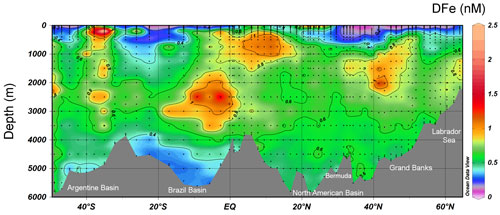
Figure: The distribution of DFe along the 17500 km long full depth transect in the western Atlantic Ocean. Click here to view the figure larger.
Reference:
Rijkenberg, M. J. A., Middag, R., Laan, P., Gerringa, L. J. A., van Aken, H. M., Schoemann, V., de Jong J. T. M., de Baar, H. J. W. (2014). The distribution of dissolved iron in the west atlantic ocean. PloS One, 9(6), e101323. doi:10.1371/journal.pone.0101323 Click here to access the paper.