
The impact of the different sources of iron on the ability of the ocean to absorb atmospheric carbon dioxide: reversing the paradigm?
Using model simulations, Tagliabue and co-authors (2014, see reference below) tested the sensitivity of the ocean to absorb the atmospheric carbon dioxide (CO2) in response to variable supply of iron. They found that while atmospheric CO2 is sensitive to sedimentary iron input, it is relatively insensitive to dust and hydrothermal iron input.
The weak reaction of atmospheric CO2 to dust input, which completely change previous paradigms, is due to the fact that dust is not the major iron input to the remote Southern Ocean, while sediment supply plays an overwhelming role in regulating export production in this oceanic area.
This works also shows that while hydrothermal input is crucial in governing the iron inventory for ~25% of the ocean, it remains restricted to the deep ocean, and has small effect on atmospheric CO2.
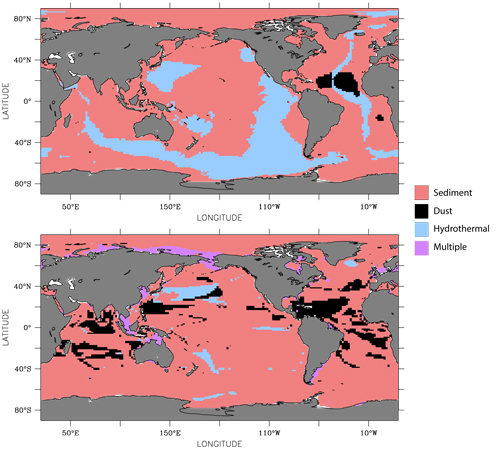
Figure: A map of the dominant iron source in controlling the dissolved iron inventory (upper) and biological carbon export flux (lower panel). Please click here to view the figure larger.
Reference:
Tagliabue, A., Aumont, O., & Bopp, L. (2014). The impact of different external sources of iron on the global carbon cycle. Geophysical Research Letters, 41(3), 920–926. doi:10.1002/2013GL059059. Click here to access the paper.