
Copper and zinc oceanic mass balance revisited
Little and co-workers (2014; see reference below) propose an update of the oceanic copper (Cu) and zinc (Zn) mass balance, with the original approach that takes into account the hitherto ignored constraint of their isotopes. They establish an up-to-date inventory of the input fluxes of these tracers with their isotopic signatures, discuss the internal processes that might fractionate both tracers and evaluate one major sedimentary sink: sediments deposited beneath an oxic water column. Although the Cu oceanic mass balance appears to be roughly in balance, the Zn one is far from being constrained… isotopes reveal that either an “isotopically light sink” or “isotopically heavy source” is missing.
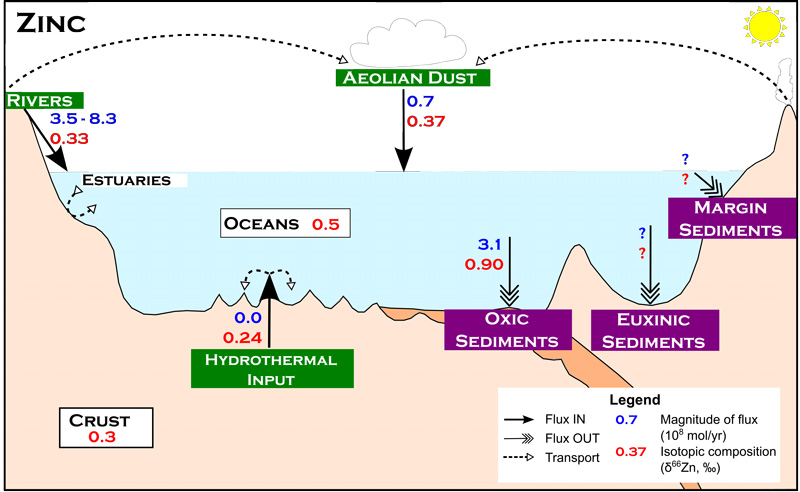
Figure: This figure illustrates the global ocean isotopic mass balance of Zn. Click here to view the figure larger.
Reference:
Little, S. H., Vance, D., Walker-Brown, C., & Landing, W. M. (2014). The oceanic mass balance of copper and zinc isotopes, investigated by analysis of their inputs, and outputs to ferromanganese oxide sediments. Geochimica et Cosmochimica Acta, 125, 673–693. doi:10.1016/j.gca.2013.07.046 Click here to view the paper.