
Cesium isotopes confirm that hydrogenetic iron-manganese crusts are precipitating from the oxygen minimum zone to abyssal depths
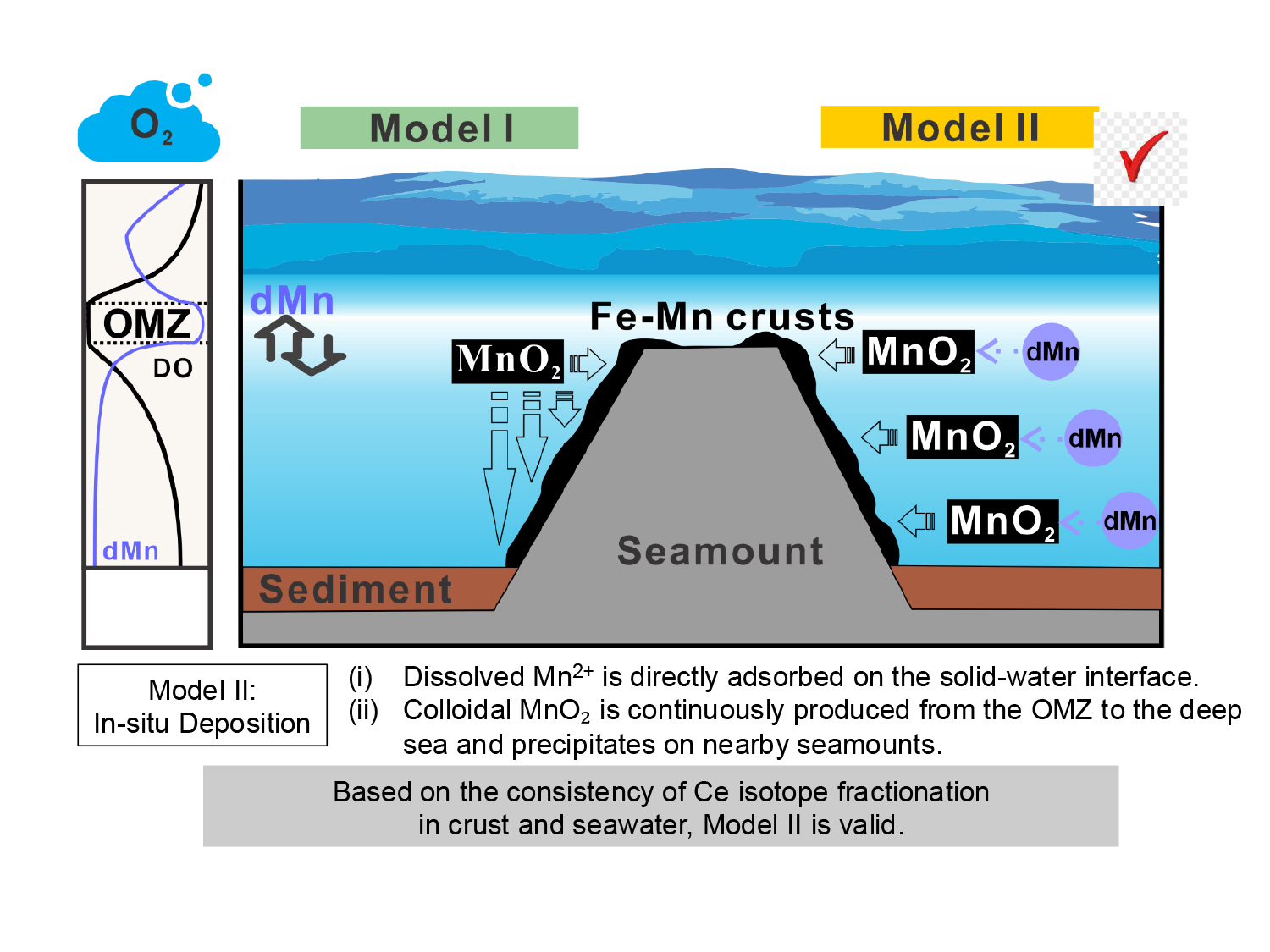
Manganese (Mn) is soluble under reducing conditions. Thus, Mn oxides were not expected to precipitate within the Oxygen Minimum Zone (OMZ). Mn and cesium (Ce) display strongly coupled cycles in seawater, the latter co-precipitating closely with the former. Thus, it’s difficult to deconvolute their cycles using concentration data alone. However, previous studies have shown preferential oxidative scavenging of isotopically light Ce on Mn oxides. This makes Ce isotopes promising proxies for tracking Mn redox cycling in marine environments.
Based on a seawater depth profile (10-6000m) of Ce isotopes (δ142Ce), compared to those measured in iron-manganese (Fe-Mn) crusts from 900 to 5000 m, Li and colleagues (2026, see reference below) showed that the δ142Ce fluctuations in hydrogenetic crusts reflect features of the ambient seawater δ142Ce profile, including the OMZ. Their data reveal that continuous oxidation of Mn from the OMZ to the deep ocean is responsible for hydrogenetic Fe-Mn encrustation in the Northwest Pacific Ocean. Thus, they demonstrate that the OMZ may represent not only a reservoir of dissolved Mn2+ but also a zone where Mn oxidation and deposition can occur.
Reference:
Li, W., R. Nakada, H. Obata, N. Kanna, I. Kim, T. Kashiwabara, Y. Asahara, H. Tazoe, M. Tanaka, A. Usui, and Y. Takahashi, 2026. Cerium Isotopes Unveil Hydrogenetic Fe-Mn Encrustation from the Oxygen Minimum Zone to the Deep Ocean. Science Advances 12 (18), eaee2813. DOI: https://www.science.org/doi/10.1126/sciadv.aee2813