Tracing the origin of iron in the equatorial Pacific: an isotopic study
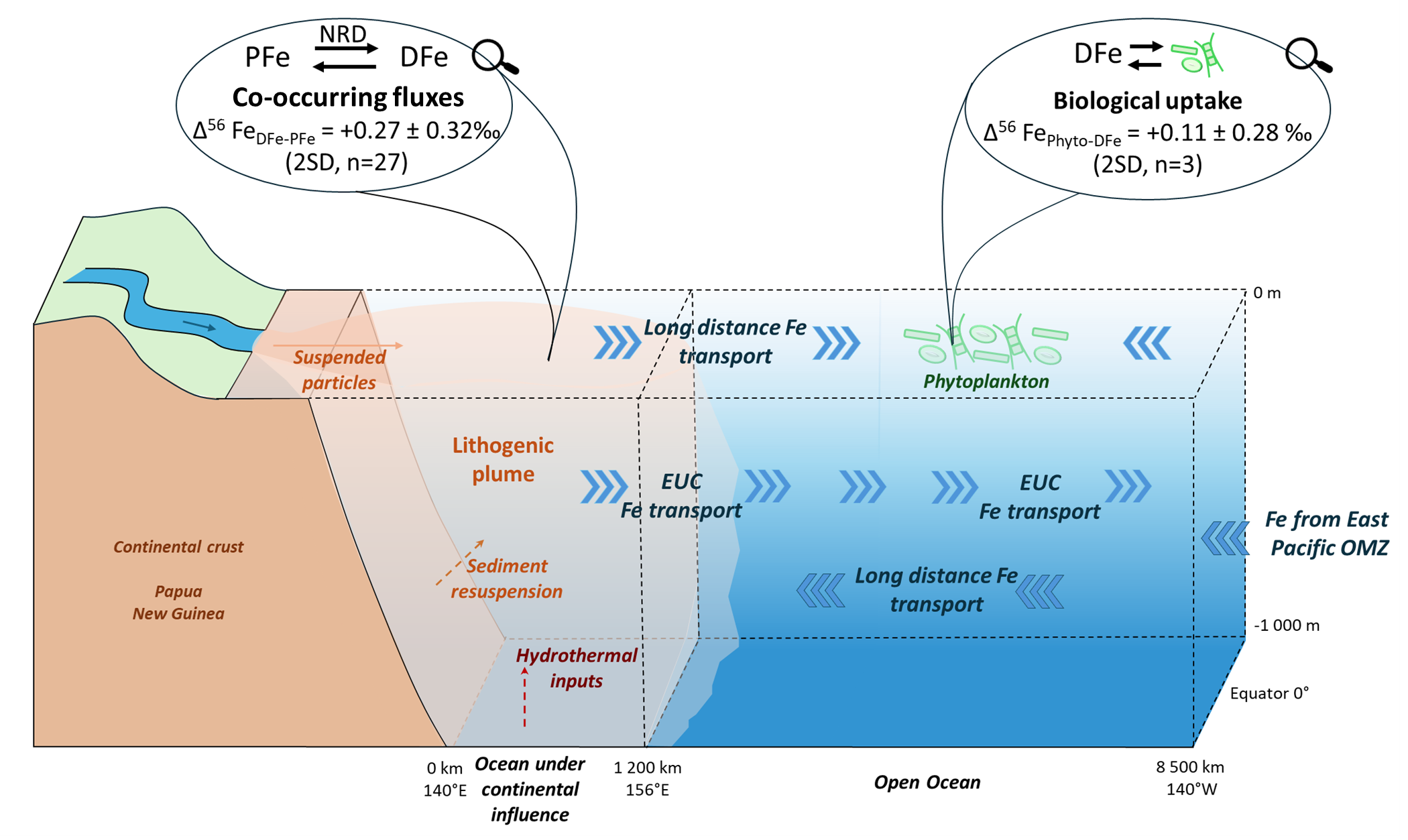
The equatorial Pacific Ocean is a region of contrasts: in the west, rivers and sediments supply large amounts of iron, while in the east, iron deficiency limits the growth of phytoplankton, which is essential for marine life and the carbon cycle. The Equatorial Undercurrent (EUC) is thought to act as a veritable nutrient highway, transporting iron from the coasts of Papua New Guinea to the coasts of Ecuador, over thousands of kilometers.
To better constrain this system, and as part of a low-carbon research approach, iron concentration and isotope data collected 20 years ago and partially published (samples collected in 2006 aboard the research vessel Kilo Moana, PI: J. Murray; Radic et al., 2011; Labatut et al., 2014) were fully analysed.
The results confirm the role of the EUC through the observation of iron isotopic signature preservation over more than 8,500 km, and trace new iron inputs from the Eastern Pacific Oxygen Minimum Zone into the central Pacific. This article shows that exchange processes play a significant role in controlling the iron cycle. Exchange processes between dissolved and particulate iron phases, without redox reactions, are shown to dominate iron cycling throughout the water column up to 1,200 km from the source. This mechanism is not yet accounted for in biogeochemical models. Finally, the data suggest minimal isotopic fractionation associated with phytoplankton uptake.
References:
Camin, C., Labatut, M., Pradoux, C., Murray, J. W., & Lacan, F. (2026). Iron isotope insights into equatorial Pacific biogeochemistry. Ocean Science, 22, 791–820. Access the paper: 10.5194/os-22-791-2026
Labatut, M., Lacan, F., Pradoux, C., Chmeleff, J., Radic, A., Murray, J. W., Poitrasson, F., Johansen, A. M., & Thil, F. (2014). Iron sources and dissolved‐particulate interactions in the seawater of the Western Equatorial Pacific, iron isotope perspectives. Global Biogeochemical Cycles, 28, 1044–1065. Access the paper: 10.1002/2014gb004928
Radic, A., Lacan, F., and Murray, J. W.: Iron isotopes in the seawater of the equatorial Pacific Ocean: New constraints for the oceanic iron cycle, Earth Planet Sc. Lett., 306, 1–10. Access the paper: 10.1016/j.epsl.2011.03.015