
The development of the modern Antarctic Circumpolar Current occurred much later than previously thought!

Evangelinos and his colleagues (2024, see reference below) are challenging the widespread belief that the onset of the Antarctic Circumpolar Current (ACC) was solely triggered by the opening and deepening of Southern Ocean Gateways (Drake Passage, Tasmanian Gateway). They based their conclusions on the analyses of neodymium isotopes (in fish debris, bones and teeth) and sortable silt records from sediment cores collected in the Southwest Pacific and South Indian Oceans spanning the past 31 million years. This exceptional set of proxy-based data reveal the absence of a vigorous, deep-reaching ACC before ∼10 Ma. The authors suggest that the onset of the modern-like, deep-reaching ACC was a result of an enhanced density contrast and the intensification of the South Westerly Winds (SWW) across the Southern driven by the increased Antarctic glaciation following the middle Miocene Climatic Optimum (~14 Ma).
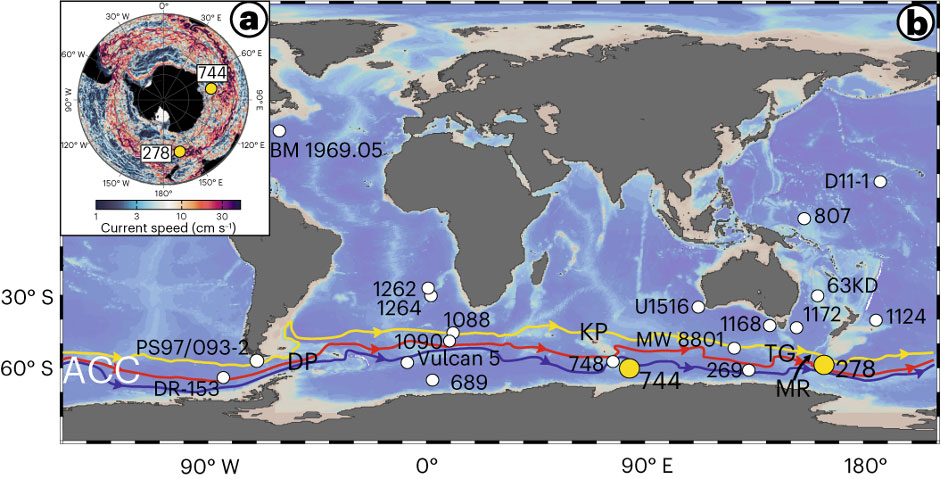
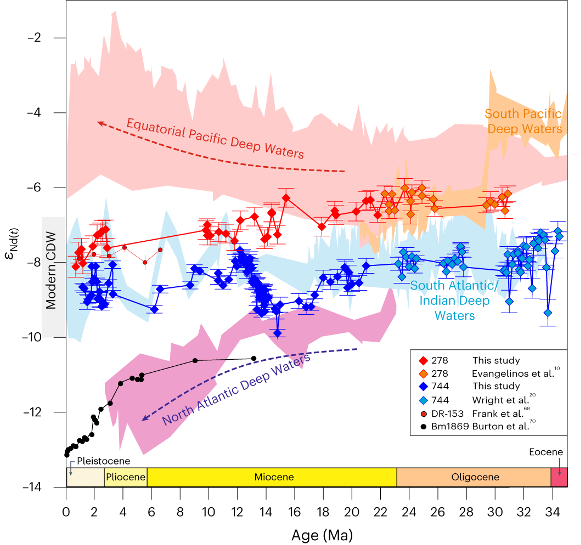
Figure 1: a) Map of current speeds in the Southern Ocean and location of our study sites (yellow dots): DSDP 278 and ODP 744. Warmer red colours represent higher current speeds. B) ACC fronts (mean positions), Subantarctic Front (yellow), Polar Front (red) and Southern ACC Front (blue).
Figure 2: Comparison of fish debris εNd(t) data from DSDP Site 278 and ODP Site 744 with other authigenic Nd records (fish debris and ferromanganese crusts) from the Atlantic, Indian and Pacific oceans, indicating the evolution of deep water masses over the past 34 Ma.

Reference:

Evangelinos, D., Etourneau, J., van de Flierdt, T. et al. Late Miocene onset of the modern Antarctic Circumpolar Current. Nat. Geosci. (2024). https://doi.org/10.1038/s41561-023-01356-3

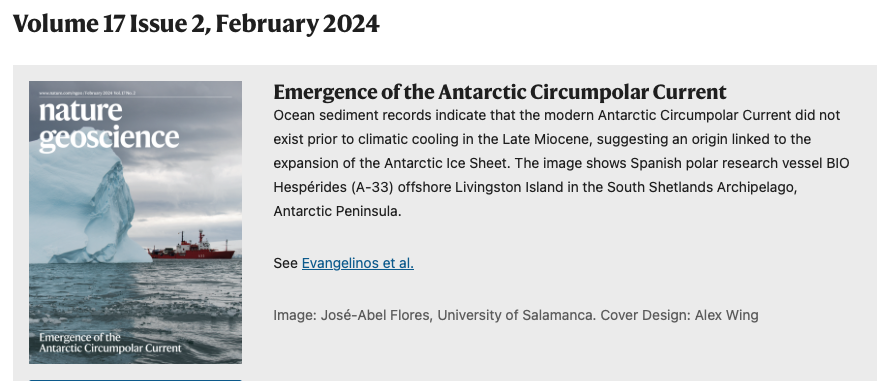
This paper made the cover of the February 2024 issue of the Nature Geoscience Journal (see image below)! Congratulations to all co-authors!
Latest highlights

Continuous record of the Antarctic Circumpolar Current latitude over the last glacial-interglacial cycles

The meridional positions of the oceanic fronts separating subtropical and Antarctic waters are key to constraining the mechanisms that drive the degassing of deeply-stored CO2 at the end of the glacial periods…

23 Million Years of iron sources reconstructed in the Northwest Pacific Ocean using iron isotopes in a ferromanganese crust

Using iron isotopes and elemental records, Chu and co-workers analysed an iron-manganese crust recovered from the Hongyan Seamount, and reconstructed the sources of dissolved Fe to the Northwest Pacific Ocean…

Variability of the past deep-water masses in the Arabian Sea over the last 41ka

Shukla and colleagues propose a high-resolution authigenic ƐNd record measured from a sediment core located in the eastern Arabian Sea…

Arctic outflows to Davis Strait and the Labrador Sea traced by radionuclide distributions

This study demonstrates that Arctic outflows through the Canadian Arctic Archipelago play a much more significant role than previously recognised.

Rechercher