
Overlooked riverine contributions of dissolved neodymium and hafnium to the Amazon estuary and oceans
The Amazon River is the largest river in the world. It discharges 20% of global freshwater runoff, resulting in a freshwater plume rich in nutrients and trace elements entering the Atlantic Ocean, increasing productivity and atmospheric CO2 removal via the biological pump (Cooley et al., 2007; Subramaniam et al., 2008). Therefore, it is crucial to constrain the factors controlling the Amazon’s supply of trace elements to the Atlantic Ocean.
Xu and colleagues (2023, reference below) investigated the isotopic composition of dissolved neodymium (Nd) and hafnium (Hf), as well as particulate Nd, and the concentrations of dissolved rare earth elements, yttrium, and Hf in surface waters along the entire salinity gradient of the Amazon estuary. The samples were obtained in April–May 2018 during RV Meteor cruise M147, the official process study GApr11 of the international GEOTRACES programme, and for the first time included the outflow of the neighboring Pará River south of the Amazon mouth. The results reveal significant dissolved Nd and Hf inputs from the Pará River to the outer Amazon estuary accounting for 45–100% of the riverine Nd fraction. The unexpectedly high inputs from the Pará River led to a revision of the global riverine Nd dataset and the refinement of an empirical relationship between riverine Nd concentrations and pH. This allowed a revised estimate of the global dissolved riverine Nd flux (gross) of 5.7 × 10⁹ g yr-1, which is at least three times higher than commonly used values. This work sheds new light on the behavior of trace elements in estuaries and suggests a future focus on the contributions of under sampled low-pH rivers to global fluxes.
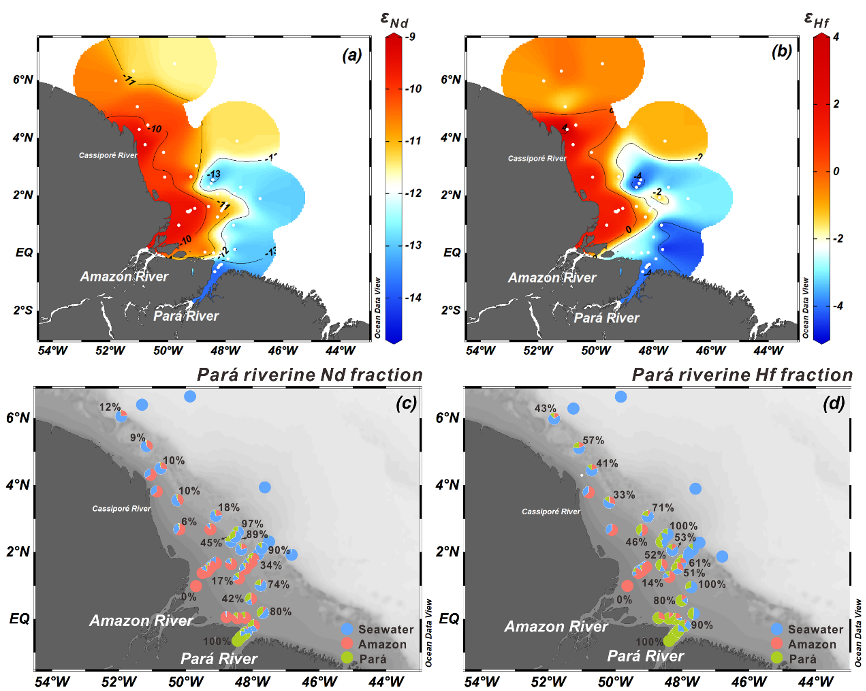
Figure: Distributions of Nd and Hf isotopes (εNd, εHf) and water fractions of the Pará River, the Amazon River and Atlantic seawater in the Amazon estuary. Distributions of εNd (a) and εHf (b) in the estuary. Pará riverine Nd fraction (c) and Hf fraction (d) displayed numerically. Fractions of Pará River water, Amazon River water and Atlantic seawater in the Amazon estuary are represented as pie charts. Figures were produced using Ocean Data View (https://odv.awi.de/).
References:
Cooley, S.R., Coles, V.J., Subramaniam, A. and Yager, P.L. (2007) Seasonal variations in the Amazon plume-related atmospheric carbon sink. Global Biogeochemical Cycles 21, GB3014. Access the paper: https://doi.org/10.1029/2006GB002831.
Subramaniam, A., Yager, P., Carpenter, E., Mahaffey, C., Björkman, K., Cooley, S., Kustka, A., Montoya, J., Sañudo-Wilhelmy, S. and Shipe, R. (2008) Amazon River enhances diazotrophy and carbon sequestration in the tropical North Atlantic Ocean. Proceedings of the National Academy of Sciences 105, 10460-10465. Access the paper: https://doi.org/10.1073/pnas.0710279105.
Xu, A., Hathorne, E., Laukert, G. and Frank, M. (2023) Overlooked riverine contributions of dissolved neodymium and hafnium to the Amazon estuary and oceans. Nat Commun 14, 4156. Access the paper: https://doi.org/10.1038/s41467-023-39922-3.