
Decoupling of barium and silicon at the Congo river-dominated Southeast Atlantic Margin: combined Barium and silicon isotope evidence

Zhang and co-authors (2023, see reference below) conducted a comprehensive study to investigate the biogeochemical cycles of barium (Ba) and silicon (Si) and their relationship during transport from the Congo River mouth along the southwestern African shelf to the open northern Angola Basin, as part of the GEOTRACES eastern South Atlantic Ocean GA08 cruise (Meteor 121). The study employed a combination of stable Ba (δ138Ba) and Si (δ30Si) isotopes, along with Ba and Si fluxes estimated based on radioactive radium isotopes (228Ra). The authors have observed and demonstrated:

  • Stronger enrichment of dissolved barium (dBa) than silicon (dSi) in the shelf-zone of the Congo plume
  • Diatom silica production has negligible effect on dissolved Ba isotopic compositions in large river plumes
  • Marked dBa enrichment (up to 24 nM) in the deep water of the northern Angola Basin likely originating from high benthic inputs

Their findings reveal a pronounced decoupling of Ba and Si at the Congo River-dominated Southeast Atlantic margin and highlight the strong influence of the margin on marine Ba cycling. Furthermore, their research suggests that the association between concentrations of dissolved Ba (dBa) and Si (dSi) across the global ocean is primarily a consequence of the large-scale ocean circulation.
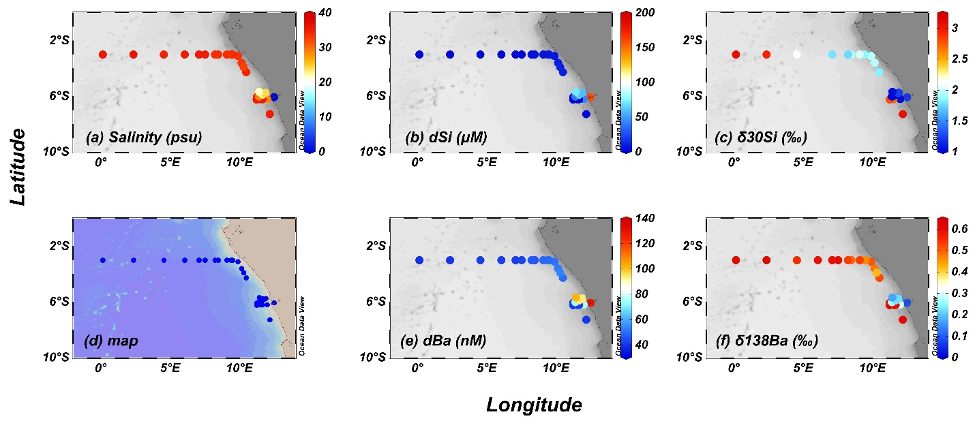
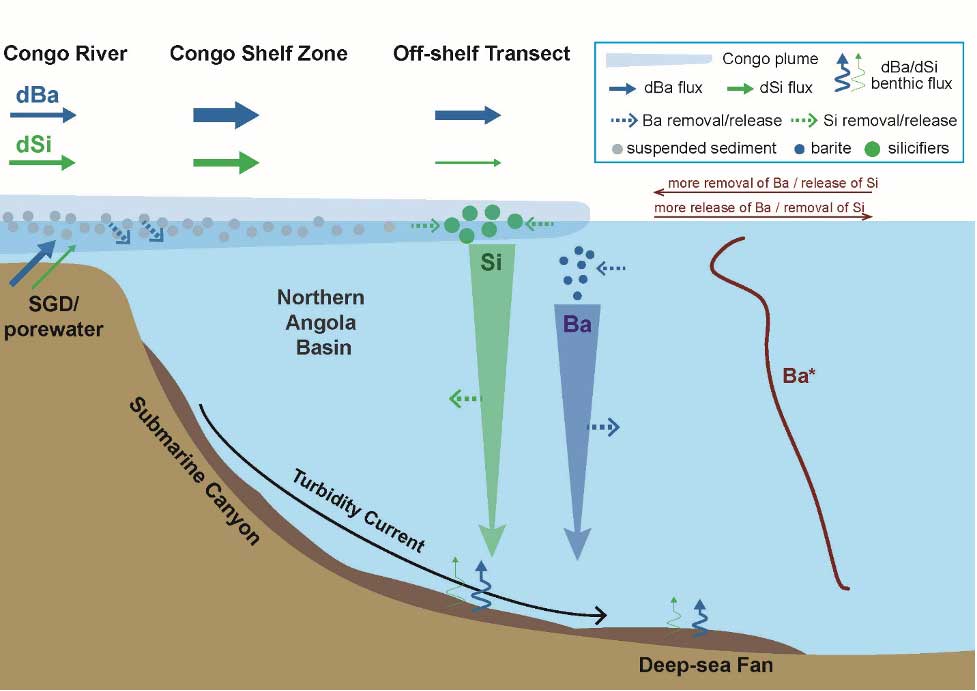
Figure 1: Surface distributions of (a) salinity, (b) dSi, (c) δ30Si, (e) dBa, and (f) δ138Ba following the Congo River plume along its flow path off the West African coast to a connected off-shelf latitudinal section at 3°S in the northern Angola Basin. (d) shows the sampling stations.
Figure 2: This conceptual figure illustrates the decoupling of Ba and Si at the Congo River-dominated Southeast Atlantic margin. The thickness of the solid line arrows represents the changes in the fluxes of dBa and dSi from the Congo River to the Congo-shelf-zone and the off-shelf transect. The arrows representing dBa and dSi fluxes from the Congo River are normalized to have equal thickness. The vertical profile of Ba* (the deviation of dBa from the dBa-dSi correlation in a defined oceanic area) reflects the decoupling of Ba and Si. The data used for this profile were collected from a station in the northern Angola Basin close to the margin.

Reference:

Zhang, Z., Yu, Y., Hathorne, E. C., Vieira, L. H., Grasse, P., Siebert, C., Rahlf, P., Frank, M. (2023). Decoupling of barium and silicon at the Congo River-dominated Southeast Atlantic margin: Insights from combined barium and silicon isotopes. Global Biogeochemical Cycles, 37, e2022GB007610, Access the paper: https://doi.org/10.1029/2022GB007610

Latest highlights

Contrasting organic carbon  remineralisation rates revealed by particulate excess barium in the North Pacific and South China Sea

Yuan and co-workers quantify organic carbon remineralisation in the twilight zone of the China Sea using particulate excess barium as a proxy…

Sedimentary controls on seawater nickel distributions and nickel isotope compositions: a two steps study

Nickel isotopic mass balance in the ocean stands among the less understood so far…

23 million years of productivity reconstructed in the Central Pacific Ocean using past and modern proxies

Using diverse geochemical proxies, Chu and colleagues analysed an iron–manganese crust to reconstruct central Pacific productivity over the past 23 million years.

Lead isotopes reveal that hydrothermal variability is driven by Sea‐Level change and transient magmatism

De and colleagues present the first millennial-scale reconstruction of hydrothermal variability at a mid-ocean ridge using lead isotopes from iron-manganese coatings…

Rechercher