
Neodymium isotopic compositions and rare earth element data evidence boundary exchange in the southwestern tropical and equatorial Pacific
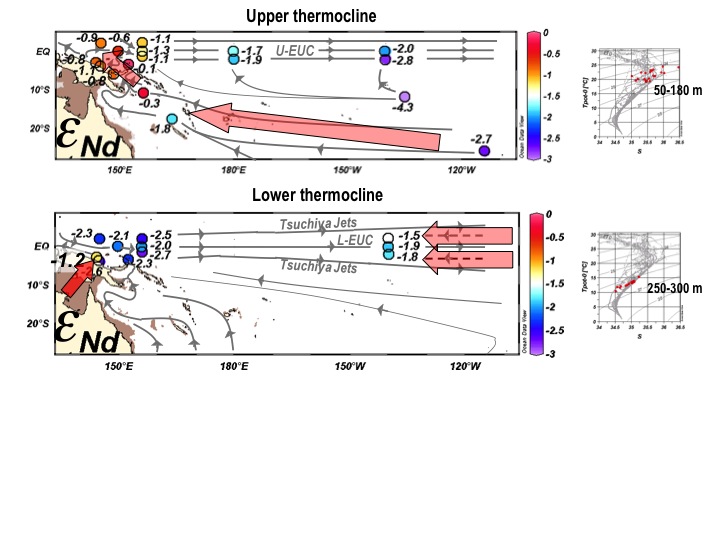
New rare earth element (REE) concentrations and neodymium (Nd) isotopic compositions measured between the southwestern Tropical and the central equatorial Pacific (112 samples) support the hypothesis that the main process driving the geochemical supply in this area is boundary exchange. Nd signatures confirm the major role of the Papua New Guinea coast but also reveal new candidates such as French Polynesia, Vanuatu, Fiji or Galapagos to explain the progressive geochemical enrichment of the waters along their pathways. The positive europium anomaly characterizing the REE patterns of the water masses also trace these continental inputs.
Click on the image to view it larger.
Figure: εNd of the dissolved fraction of the upper (top) and lower (bottom) thermocline water masses flowing in the Southwestern and Equatorial Pacific, identified by red dots on the adjacent θ-S plots. Each dot corresponds to a Nd sample and its colour refers to its εNd value. Currents are represented by grey arrows. Large red arrows illustrate areas along the water mass pathways where radiogenic supplies likely occur to explain observed εNd changes. The bathymetry shallower than 250m is coloured in brown.
Reference :
Grenier, M., C. Jeandel, F. Lacan, D. Vance, C. Venchiarutti, A. Cros, and S. Cravatte (2013), From the subtropics to the central equatorial Pacific Ocean: Neodymium isotopic composition and rare earth element concentration variations, /J. Geophys. Res. Oceans/, 118, doi:10.1029/2012JC008239.