
Dissolved cobalt enrichments over the Kerguelen plateau confirm that most of the natural fertilization is due to partial dissolution of local basalts
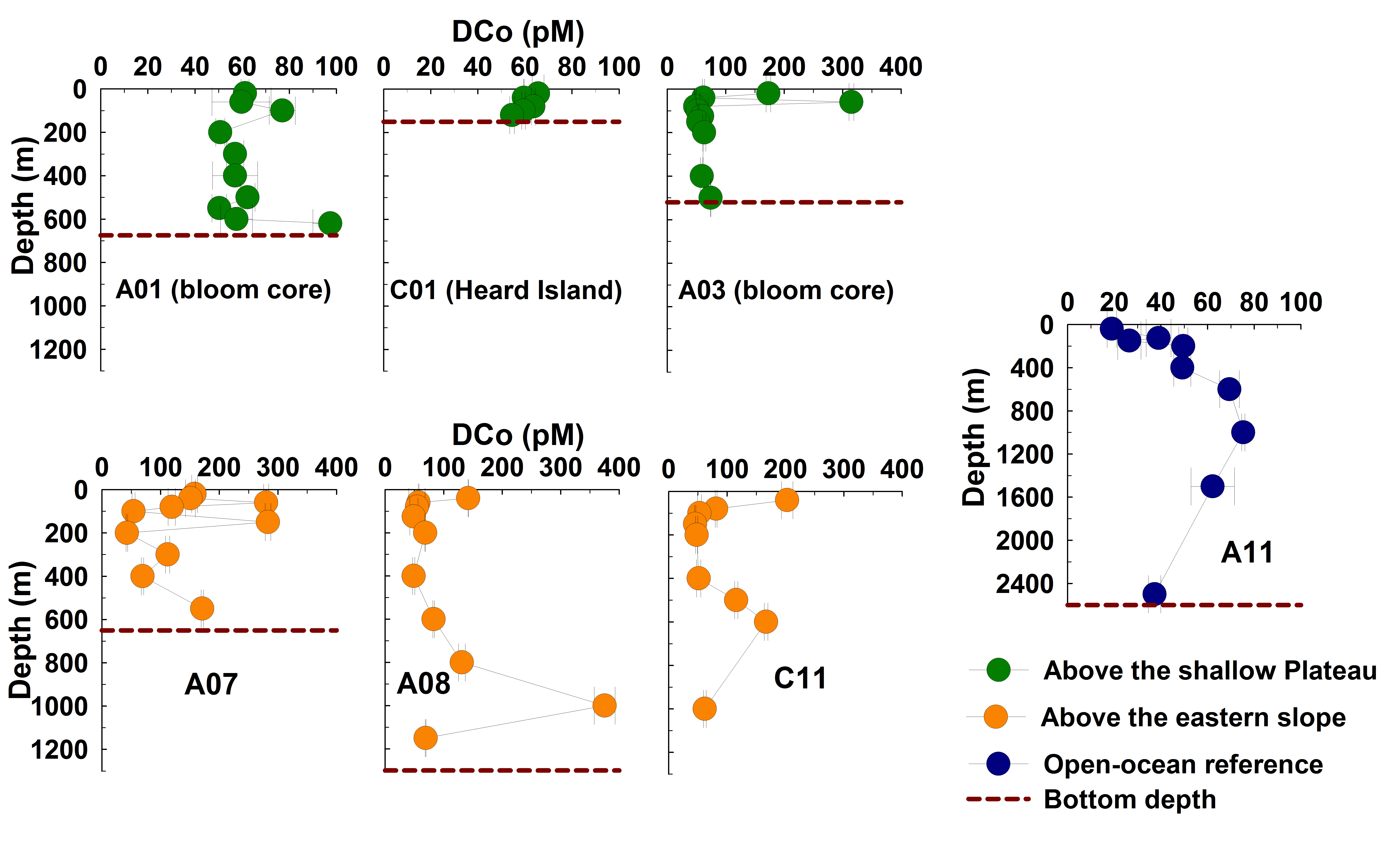
Exceptionally high dissolved cobalt (Co) concentrations have been measured in the surface waters above the Kerguelen Plateau (KEOPS), and in intermediate and deep waters above its eastern slope. Lateral advection and dissolution of Co contained in basalt sediments around Heard Island were shown to imprint the process of surface enrichment over the plateau. Dissolved Co enrichment was strongest at the intercept of the eastern slope with intermediate and deep waters, probably due to more efficient mobilisation of the sediments in the slope current.
Estimate of the fertilization flux of iron inferred by using dissolved Co as a tracer of basalt sources is consistent with preceding ones (Zhang et al., DSR II, 55, 638-652, 2008; Chever et al., Biogeosciences, 7, 455-468, 2010), and the calculated iron supply matches with the phytoplankton demand (Sarthou et al., DSRII, 55, 734-751, 2008).
Reference:
Bown, J., Boye, M., Laan, P., Bowie, A. R., Park, Y.-H., Jeandel, C., and Nelson, D. M.: Imprint of a dissolved cobalt basaltic source on the Kerguelen Plateau, Biogeosciences, 9, 5279-5290, doi:10.5194/bg-9-5279-2012, 2012. Paper.