
A new application of aerosol iron isotopes: tracing anthropogenic iron; an example of the North Atlantic Ocean

Conway and co-authors (2019, see reference below) present the first evidence that anthropogenic iron (Fe) from combustion sources is visible at the basin scale, using iron isotopic composition (δ56Fe) analysis of the soluble aerosol phases collected during GEOTRACES cruise GA03 in the North Atlantic Ocean. Off Sahara, soluble aerosol samples have near-crustal δ56Fe whereas those from near North America and Europe display δ56Fe values as light as −1.6‰. Coupled to aerosol deposition modeling these results reveal that soluble anthropogenic aerosol Fe flux to the global surface oceans is highly likely to be underestimated.
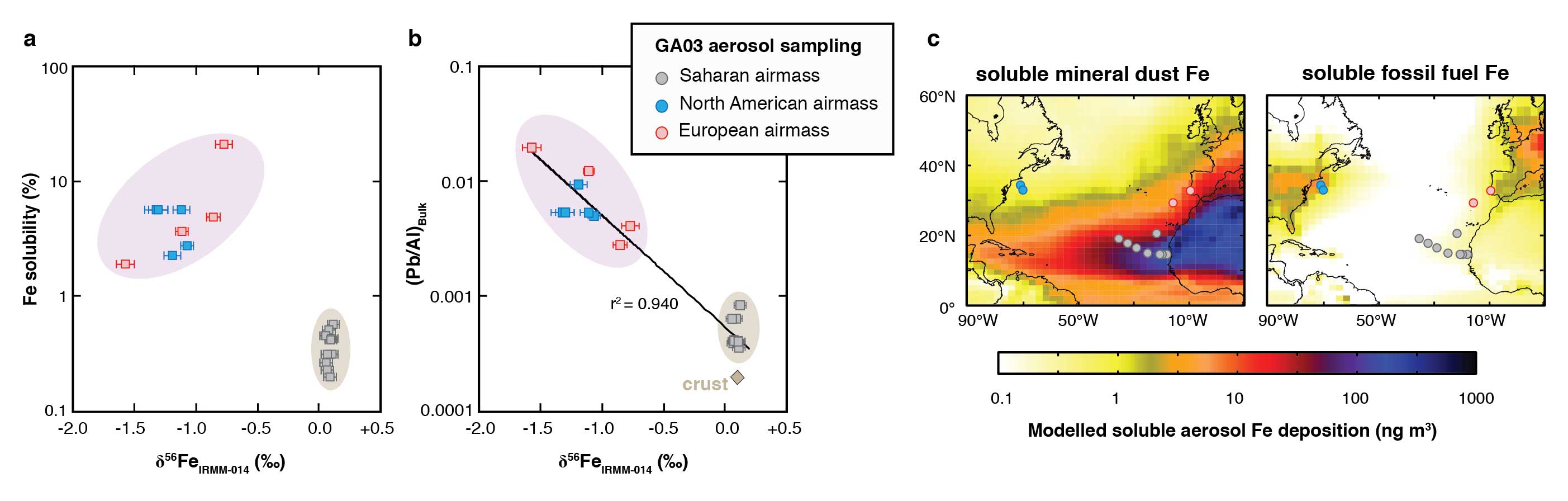
Figure: Tracing anthropogenic iron with iron isotopes (adapted from Conway et al., 2019). Panels a and b show that aerosols collected from near the Sahara have low solubility, a near-crustal iron isotope composition (beige circle) and a near-crustal Pb/Al composition (beige diamond). In contrast, those collected from near North America or Western Europe have very soluble iron, very light iron isotopes and are very enriched in Pb, indicating pollution from humans. When sampling points are overlain on output from dust modelling, it can be seen that the light iron isotopes correspond to where fossil fuel iron is expected to be important, and the crustal iron isotopes correspond to where natural dust iron is most important (panel c). Click on the image to view it larger.

Reference:

Conway, T. M., Hamilton, D. S., Shelley, R. U., Aguilar-Islas, A. M., Landing, W. M., Mahowald, N. M., & John, S. G. (2019). Tracing and constraining anthropogenic aerosol iron fluxes to the North Atlantic Ocean using iron isotopes. Nature Communications, 10(1), 2628. DOI: https://doi.org/10.1038/s41467-019-10457-w

Latest highlights

Mercury content and isotopes in bird’s guano: a window to reconstruct past climates

By analysing peat cores, Chuxian Li and her colleagues have shown how populations of nesting seabirds have fluctuated on a sub-Antarctic Island over the last 8,000 years.

Contraction of North Atlantic Deep Water during glacial times: a paradigm called into question

Blaser and co-authors propose a new distribution of deep-water masses in the Atlantic Ocean during the Last Glacial Maximum and the Heinrich Stadial..

Authigenic radiogenic neodymium isotope composition traces millennial-scale overturning circulation variability in the Arabian Sea

The neodymium isotopic signature of the sediment authigenic fraction is, a priori, a valuable proxy for reconstructing deep-water mass trajectories…

Magmatic activity at the Carlsberg Ridge in the Indian Ocean triggered by glacial sea-level variation

De and colleagues provide a high-resolution record of magmatic input and associated hydrothermal activity over the past 49 kyr from a core recovered from a magmatic segment of the slow-spreading Carlsberg Ridge in the Indian Ocean.

Rechercher