
A vivid picture of particle distribution and sources in the Arctic Ocean

Gardner and co-workers (2022, see reference below) proposed an extensive description of particle concentrations and chlorophyll-a fluorescence (Chl-a) distribution along GEOTRACES sections across the Arctic Ocean. The optical data in the sections were paired with particle composition on filtered samples through the whole water column. Particle distributions in the Arctic are affected by currents, stratification, ice coverage and thickness, nutrient and light availability, and biological processes. The combination of cp (a proxy for particular matter and particulate organic carbon) sections plotted with salinity, temperature, and Chl-a contours, adds a background and baseline across the entire Arctic Ocean that is useful in deciphering some of the particle dynamics of the Arctic.
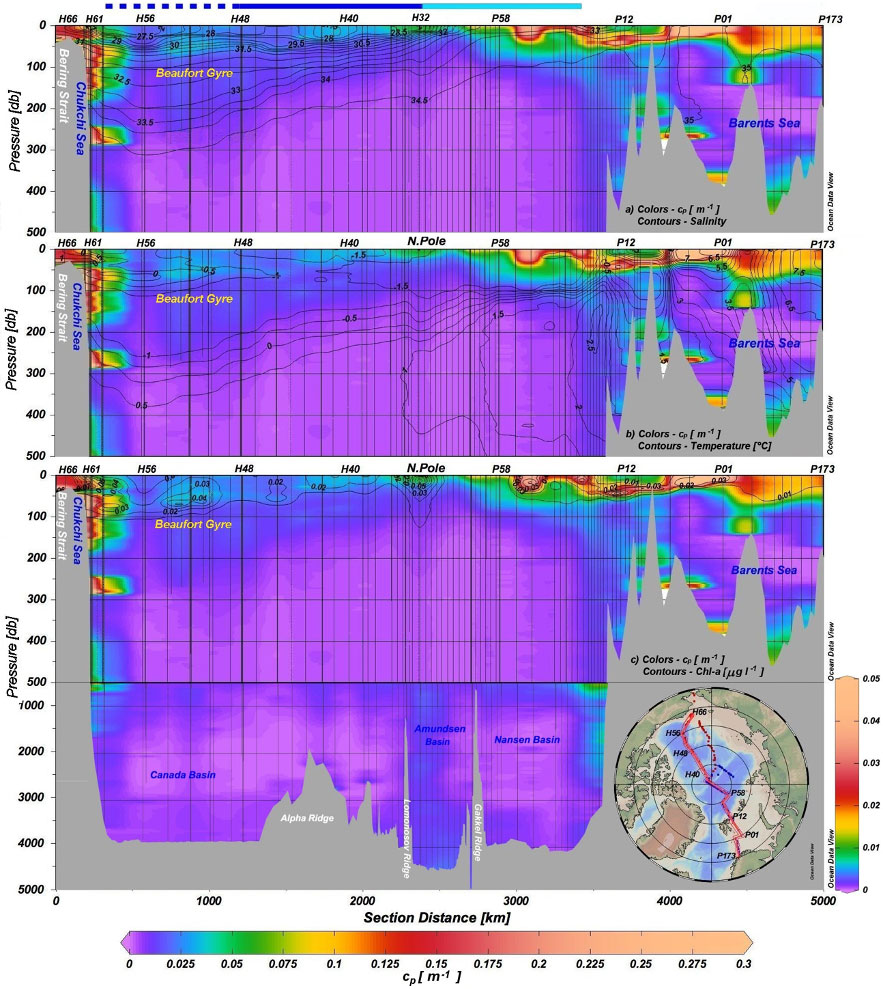
Figure: Sections of cp (m-1, a proxy for PM or POC) from the Bering Strait to Norway. Contours: a) salinity; b) temperature, °C ; and c) Chl-a, µg l-1. Range of cp is 0-0.3 m-1 in 0-500m layer (horizontal bar) and 0-0.05 m-1 in 500-5000m layer (vertical bar) to enhance cp changes at depth. Blue lines at the top – ice cover: dashed – 20% to 80%, dark blue – >80%, light-blue – ice reported from R/V Polarstern. No line ~ ice-free. Orange line on map – stations included in these sections.

Reference:

Gardner, W. D., Richardson, M. J., Mishonov, A. V., Lam, P. J., & Xiang, Y. (2022). Distribution, Sources, and Dynamics of Particulate Matter Along Trans‐Arctic Sections. Journal of Geophysical Research: Oceans, 127(6). Access the paper: 10.1029/2021jc017970

Latest highlights

Do not mourn Nobias any longer: InertSep ME-2 is coming!

Thanks to the thorough development proposed by Alifia and co-workers, the community may have a solution to the shortage of Nobias Chelate PA-1…

Long-range transport of iron off the Antarctic Peninsula

Tian and co-authors investigate dissolved iron concentrations and isotope compositions in the western Weddell Sea…

Seasonal variation of the dissolved iron ligands in the South Atlantic sector of the Southern Ocean

In the ocean, up to 99% of the dissolved iron is strongly complexed with organic compounds known as iron-binding ligands…

Tracing the origin of iron in the equatorial Pacific: an isotopic study

The equatorial Pacific Ocean is a region of contrasts: in the west, rivers and sediments supply large amounts of iron, while in the east, iron deficiency limits the growth of phytoplankton…

Rechercher