
Distributions, boundary inputs, and scavenging processes of trace metals in the East Sea (Japan Sea)
The distributions of dissolved iron (Fe), manganese (Mn), cobalt (Co), copper (Cu), cadmium (Cd), and nickel (Ni) in the East Sea (Japan Sea) established by Seo and his colleagues (2022, reference below) show pronounced atmospheric and shelf inputs of these trace elements, except for Ni.
More particularly, unusually high concentrations of Fe and Mn (13 and 57 nmol kg-1, respectively) are observed in the bottom layer of the Ulleung Basin (southwestern part of the East Sea), which likely reflects benthic inputs. These inputs seem to be associated with the diffusion of dissolved organic matter (DOM) complexed Fe and Mn from the sediment to the overlying seawater.
In contrast, the Co concentrations in the East Sea show the lowest value ever reported at similar depths in the oceans (2-8 pmol kg-1), while the surface water concentrations of the same element are 2-5 fold higher than those in the major oceans.
The authors attribute these surprising trace element distributions to an interplay between atmospheric and shelf inputs and efficient scavenging allowed by high sinking particle fluxes in this area.
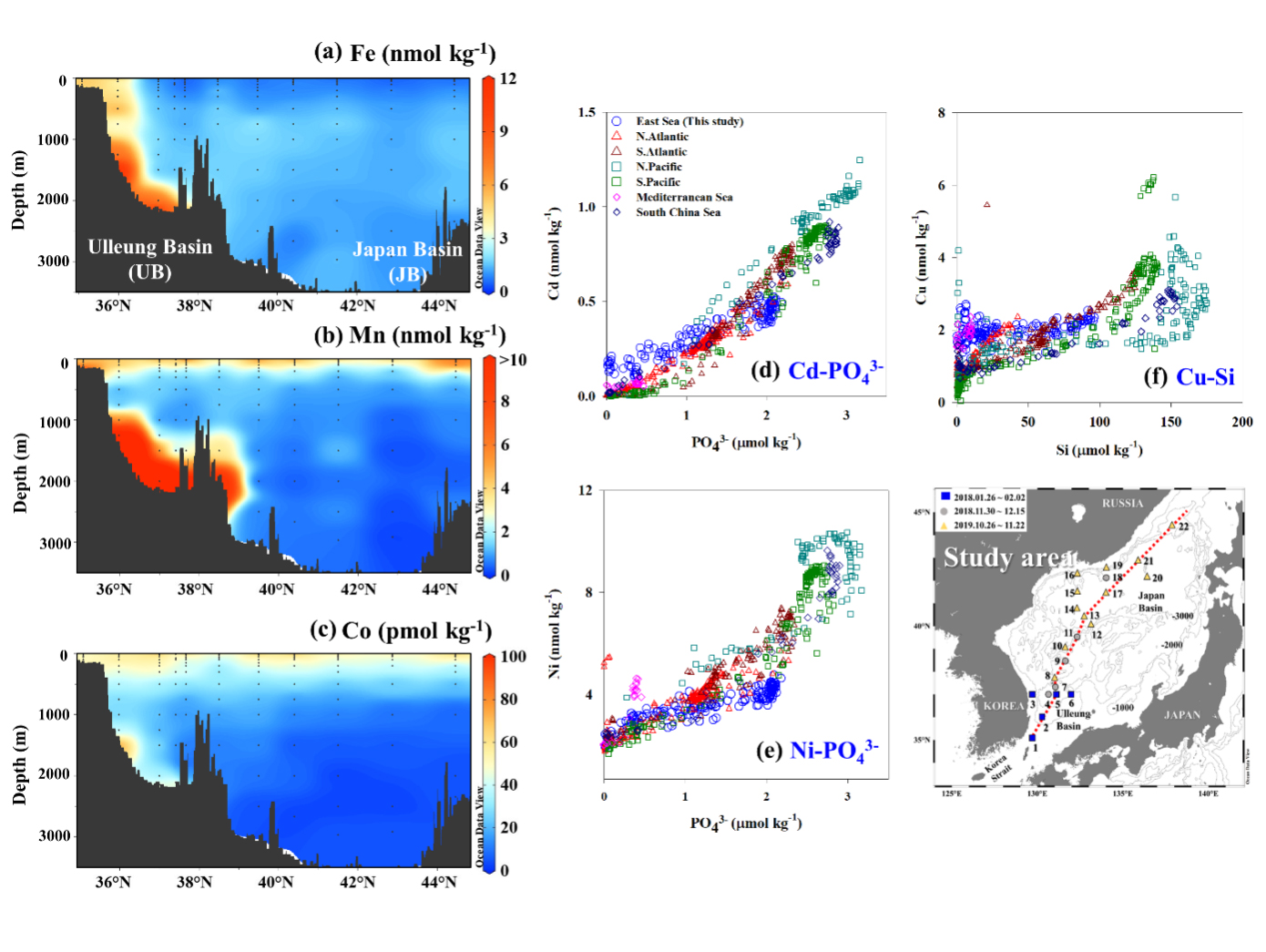
Figure caption: The distributions of dissolved (a) Fe (nmol kg-1), (b) Mn (nmol kg-1), and (c) Co (pmol kg-1) and the plots of nutrients versus (d) Cd (nmol kg-1), (e) Ni (nmol kg-1), and (f) Cu (nmol kg-1) in the East Sea.
References:
Seo, H., Kim, G., Kim, T., Kim, I., Ra, K., & Jeong, H. (2022). Trace elements (Fe, Mn, Co, Cu, Cd, and Ni) in the East Sea (Japan Sea): Distributions, boundary inputs, and scavenging processes. Marine Chemistry, 239, 104070. doi:10.1016/j.marchem.2021.104070