
New neodymium concentration and isotopic data from the West Pacific Ocean
In the framework of the GEOTRACES TransGeoBioOc process study (GPpr04), seawater samples were collected at 12 stations (and up to 17 depths per stations) along the SO223T cruise transect from Busan (South Korea) to Suva (Fiji) (Figure a).
This beautiful set of Nd concentration ([Nd]) and isotopic (εNd) signature data allow Behrens and co-workers (2017, see reference below) to clarify the relative importance of different Nd sources (rivers, volcanic islands), vertical (bio)geochemical processes and lateral water mass transport on these parameter distributions in this area. Interesting unradiogenic inputs from South Korea and Chinese rivers are identified in the northern part of the section, while volcanic islands of the tropical West Pacific supply radiogenic Nd to surface and subsurface waters (Figure a, b).
A thorough discussion of these data reveals:
- Clear differences in εNd signatures of east- and westward flowing surface and subsurface currents of the zonal equatorial current system that allow tracing of small-scale (sub)surface circulation at unprecedented detail (Figure b);
- Lateral transport of extremely low preformed [Nd] from the oligotrophic North/South Pacific subtropical gyres into the study area (Figure c);
- Conservative behaviour of Nd concentrations within AAIW, southern LCDW and upwelling of UCDW in the Philippine Sea.
- Non-conservative behaviour of εNd due to boundary exchange processes, mostly along the volcanic island shelves and submarine ridges.
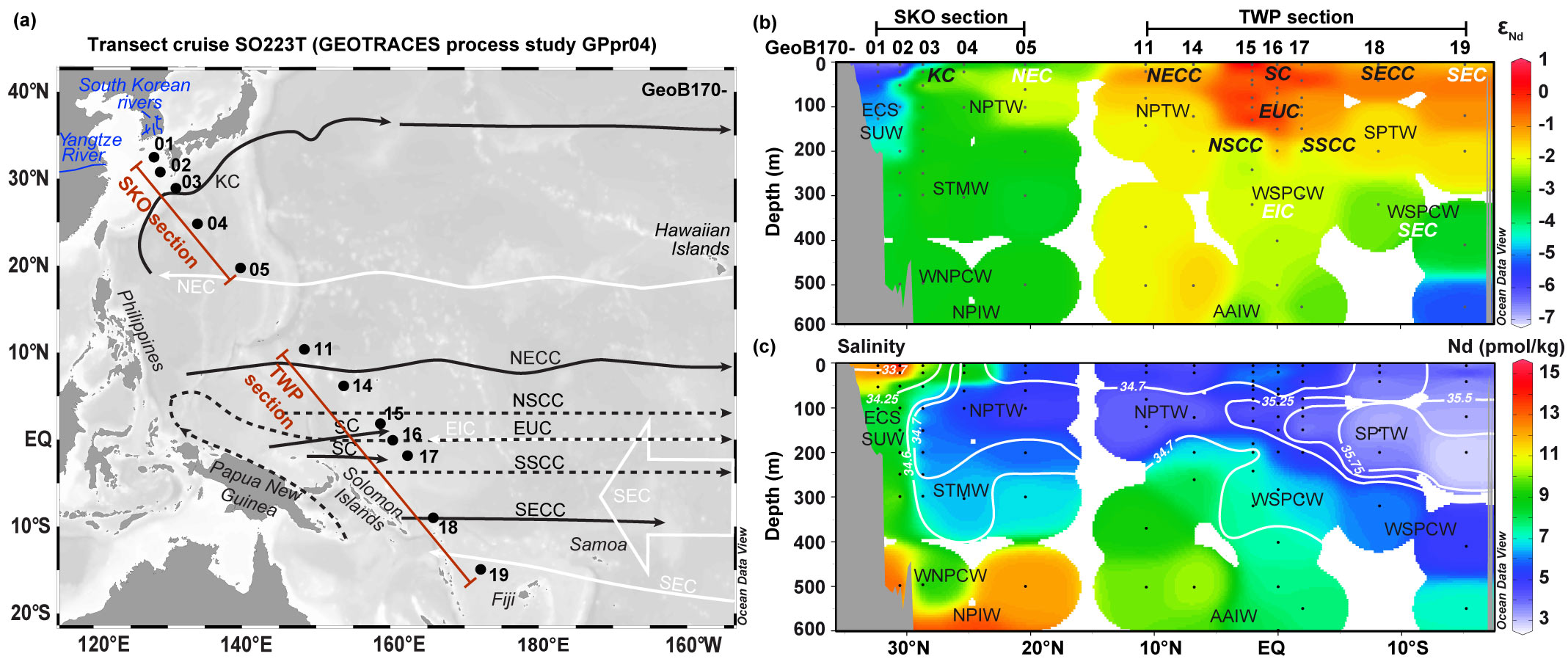
Figure: (a) Map of stations (GeoB170-) 01-05 (SKO, South Korea – open ocean section) and 11-19 (TWP, tropical West Pacific section) with Nd sources (rivers, volcanic islands) and surface (solid arrows) and subsurface (dashed arrows) westward (white) and eastward (black) currents. Upper water column (b) εNd signatures with (sub)surface currents as in (a), and (c) Nd concentrations with salinity contours along the transect and different water masses (for abbreviations see figures 1 and 4 in original article). Please click here to view the image larger.
Reference:
Behrens, M.K., Pahnke, K., Schnetger, B., & Brumsack, H.-J. (2018). Sources and processes affecting the distribution of dissolved Nd isotopes and concentrations in the West Pacific. Geochimica et Cosmochimica Acta, 222, 508–534. http://doi.org/10.1016/j.gca.2017.11.008