
Microbial trace metal trafficking on marine particles
Marine particles contain metals that can quantitatively equal or exceed the dissolved pool, but whether particulate matter presents a source for microorganism remains largely unexplored. Debeljak and colleagues (2021, see reference below) have addressed this question by a double approach, the chemical characterization and the ‘metallo’-metatranscriptome of a diverse prokaryotic community inhabiting particles in the Southern Ocean. Their study shows that the ratios of multiple metals to phosphorus are higher in particles as compared to those in heterotrophic prokaryotes, identifying particulate matter as a potential source of these elements. Using a comparative metatranscriptomics approach, Debeljak and colleagues reveal an enhanced expression of genes for the uptake of metals through various mechanisms in prokaryotes inhabiting particles. But concurrently genes involved in the control of resistance to metal toxicity, storage, sensing and regulation were also highly expressed by particle-attached prokaryotes. Their study provides evidence for the processing of nine particulate trace metals in multiple manners by diverse microbial communities. To explain these enhanced transcript inventories of distinct metal-related genes in particle-attached heterotrophic prokaryotes, the authors suggest an overarching biological property essential for life, homeostasis, as a conceptual framework.
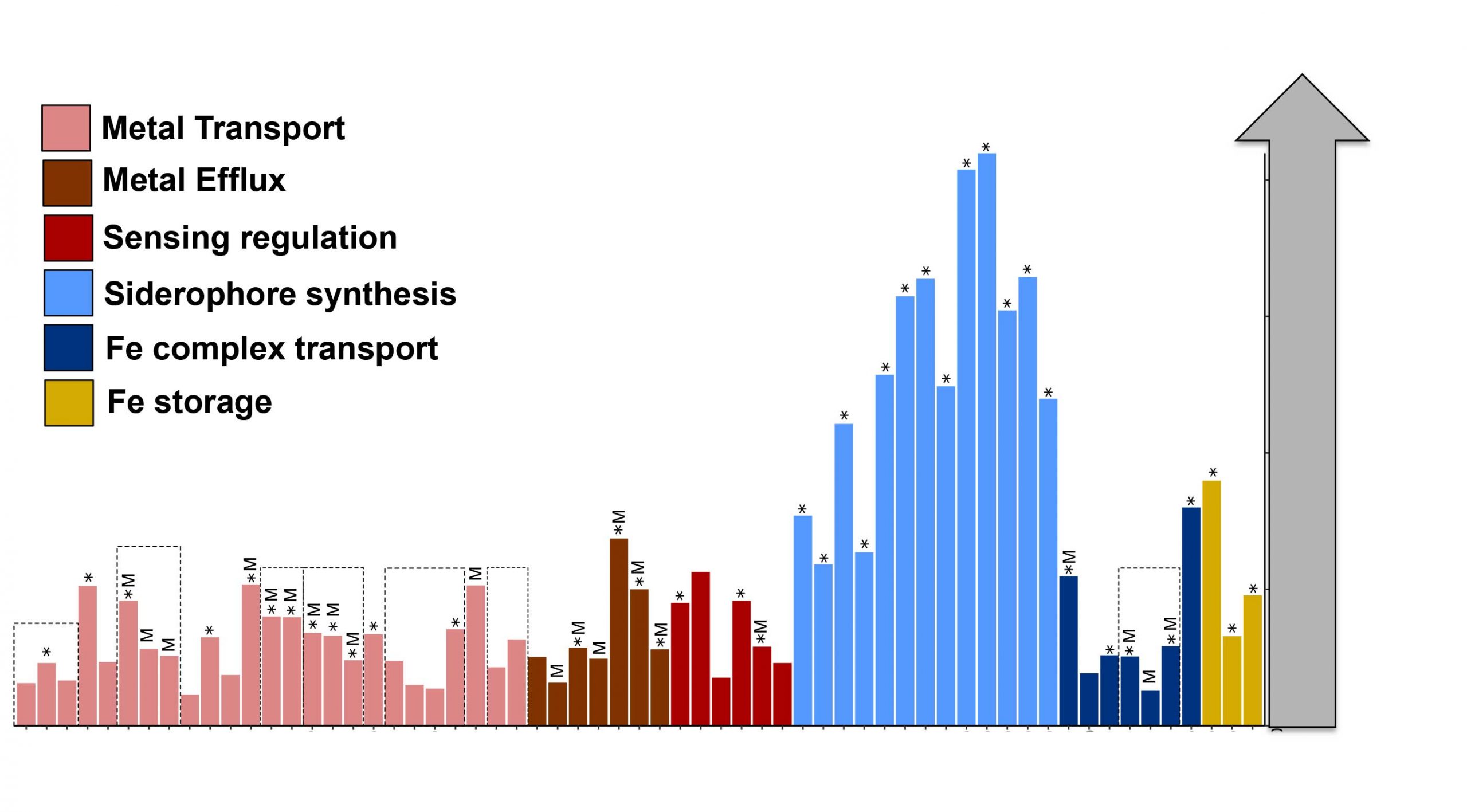
Fold changes of normalized transcript counts of KEGG orthologous genes in prokaryotic communities attached to particles as compared to those in particle-free incubations (given in Log2Fold). Significantly higher expressed transcripts (adjusted p-value <0.05) are indicated by an asterisk (*) and genes potentially implicated in the transport of multiple metals are indicated by the letter M (for multiple). Transporters for organically-bound Fe are shown separately from those for Fe 2+ and Fe 3+.
This study is published in Limnology and Oceanography and illustrated by the following Video Abstract:
Reference:
Debeljak, P., Blain, S., Bowie, A., Merwe, P., Bayer, B., & Obernosterer, I. (2021). Homeostasis drives intense microbial trace metal processing on marine particles. Limnology and Oceanography, lno.11923. DOI: https://doi.org/10.1002/lno.11923