
Amazingly detailed compilation of the silicon cycle, with an emphasis on the oceanic silicon isotope budget
Although this article is not resulting from GEOTRACES activity, its content is definitely GEOTRACES relevant. The authors constructed an up-to-date compilation of the continental silicon (Si) cycle, including the fate of Si isotopic composition in the different continental but also estuarine and marine solid and solutions.
This is a paper highly recommended by Catherine Jeandel, the GEOTRACES IPO science director.
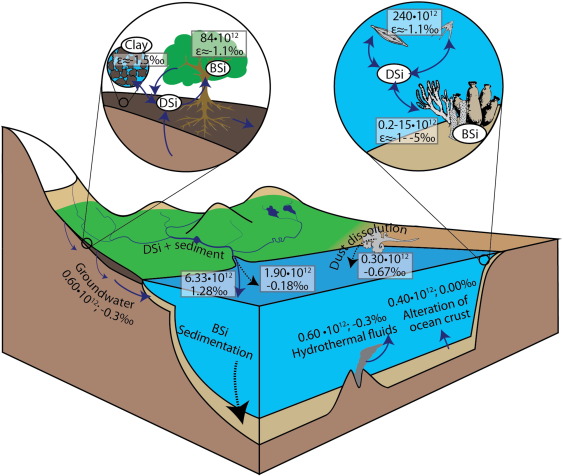
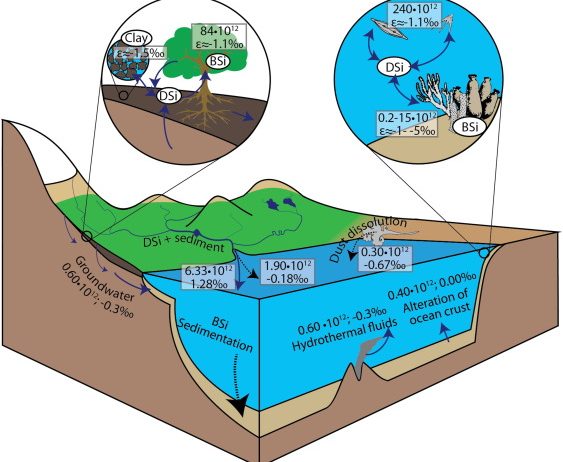
Figure: Cartoon schematic of the modern day global Si cycle. The values show the magnitudes of the fluxes (in 1012 mol yr− 1) and their associated δ30Si values (in ‰). Typical fractionations (ε, ‰) associated with production of biogenic silica (BSi) and clay minerals are shown in the inset panels. Dotted lines indicate particulate fluxes; solid lines indicate solute fluxes or transformations. Source: Frings, et al., 2016, Chemical Geology.
Reference:
Frings, P.J., Fontorbe, G., Clymans, W., De La Rocha, C.L., Conley, D.J., 2016. The continental Si cycle and its impact on the ocean Si isotope budget. Chemical Geology 425, 12-36.doi:10.1016/j.chemgeo.2016.01.020