
Informative zinc isotopic fractionation in the Southern Ocean
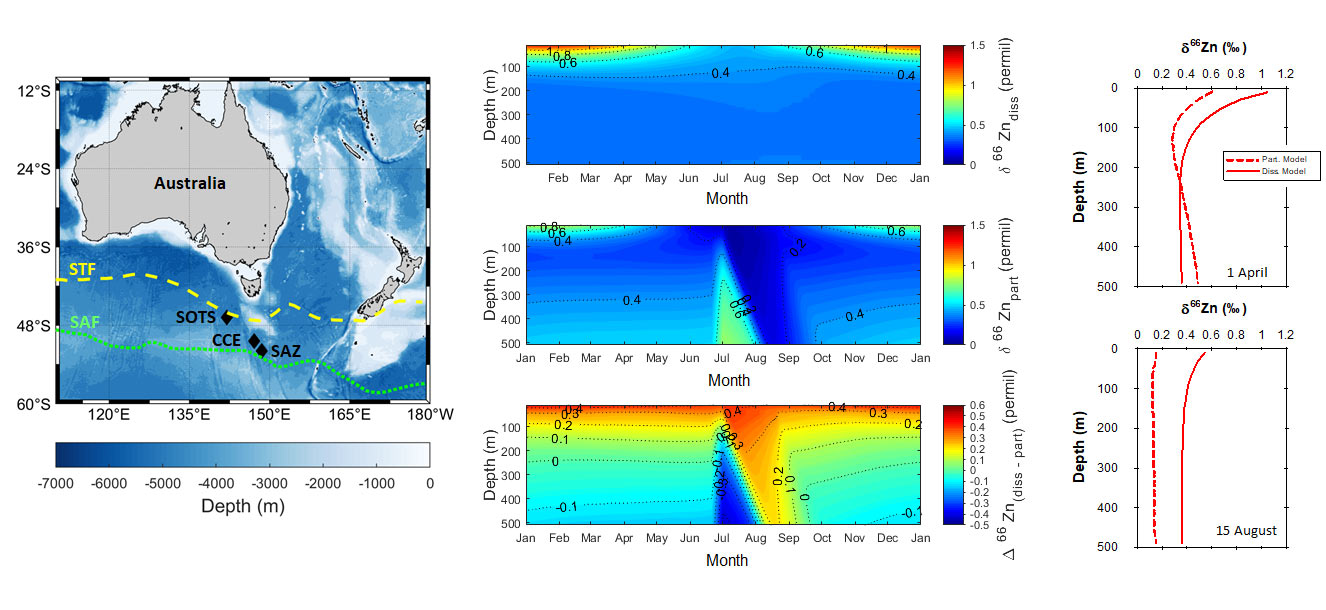
Ellwood and co-workers (2020, see reference below) established the distribution of dissolved and particulate zinc (dZn and pZn respectively) and its isotopes in the Subantarctic Zone South of Tasmania.
Concentration profiles show that zinc has a longer regeneration length scale than phosphorus and of cadmium, but shorter than copper. Modelling of the particulate profiles produced variable vertical attenuation factors of 0.82, 2.04, 2.41 and 0.28 for zinc, phosphorus, cadmium and copper respectively.
Interestingly, concentrations and isotopic Zn distributions were established inside cold-core eddy (CCE) and compared to the same parameter distributions outside the eddy.
The isotope composition of surface dZn (δ66Zndissolved) from the CCE station is ~ twice its deep water value. This is likely due to the isolated nature of the cold-core, which retains the signals of isotope fractionation, while they are likely lost by mixing outside the core.
The authors then apply a 1D-simulation to their data and show that the isotopic structure of the dissolved and particulate zinc from this specific station are determined by the interplay of processes like uptake by phytoplankton, complexation of zinc with natural organic ligands and the regeneration of zinc from particulate matter.
Reference:
Ellwood, M. J., Strzepek, R., Chen, X., Trull, T. W., & Boyd, P. W. (2020). Some observations on the biogeochemical cycling of zinc in the Australian sector of the Southern Ocean: a dedication to Keith Hunter. Marine and Freshwater Research, 71(3), 355. Access the paper: https://doi.org/10.1071/MF19200