
Transient tracers, water mass ages and mixing time scales in the Arctic Ocean

Smith and colleagues determined iodine-129 (129I), chlorofluorocarbons (CFC-11) and sulfur hexafluoride (SF6), in the Arctic Ocean in samples collected during two U.S. and one German GEOTRACES cruises that occurred in 2015 (cruises GN01 and GN04). The resulting large, quasi-synoptic tracer data sets provide an opportunity to use these transient tracers to determine water mass mean ages and mixing rates in a highly stratified, arctic, marine system. Their calculated mean age sections are conform to historical ideas of tracer ages while the mixing time is nearly constant in upper intermediate water, which reflects the influence of strong advective flow. The high mixing values found in the upper halocline are congruent with the nutrient maximum indicating that both are governed by winter shelf mixing processes.
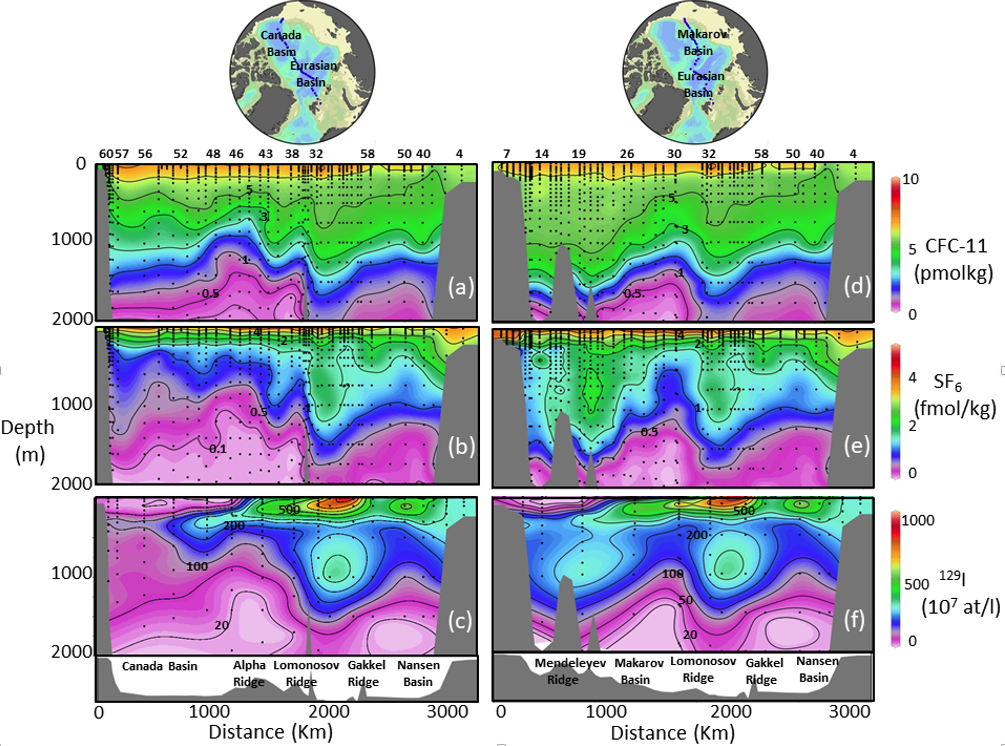
Figure: Left panels: Tracer sections across Canada Basin and Eurasian Basin for; (a) CFC-11; (b) SF6 and (c) 129I. Right panels: Tracer sections across Makarov and Eurasian Basin for; (d) CFC-11; (e) SF6 and (f) 129I. Maps of respective tracer sections are illustrated in top panels.

Reference:

Smith, J. N., Smethie Jr., W. M., & Casacuberta, N. (2022). Synoptic 129 I and CFC–SF 6 Transit Time Distribution (TTD) Sections Across the Central Arctic Ocean From the 2015 GEOTRACES Cruises. Journal of Geophysical Research: Oceans, 127(9). Access the paper: 10.1029/2021jc018120

Latest highlights

Mercury content and isotopes in bird’s guano: a window to reconstruct past climates

By analysing peat cores, Chuxian Li and her colleagues have shown how populations of nesting seabirds have fluctuated on a sub-Antarctic Island over the last 8,000 years.

Contraction of North Atlantic Deep Water during glacial times: a paradigm called into question

Blaser and co-authors propose a new distribution of deep-water masses in the Atlantic Ocean during the Last Glacial Maximum and the Heinrich Stadial..

Authigenic radiogenic neodymium isotope composition traces millennial-scale overturning circulation variability in the Arabian Sea

The neodymium isotopic signature of the sediment authigenic fraction is, a priori, a valuable proxy for reconstructing deep-water mass trajectories…

Magmatic activity at the Carlsberg Ridge in the Indian Ocean triggered by glacial sea-level variation

De and colleagues provide a high-resolution record of magmatic input and associated hydrothermal activity over the past 49 kyr from a core recovered from a magmatic segment of the slow-spreading Carlsberg Ridge in the Indian Ocean.

Rechercher