
Substantial trace metal input from the 2022 Hunga Tonga-Hunga Ha’apai eruption into the South Pacific Ocean
The Hunga Tonga-Hunga Ha’apai (HTHH) volcano violently erupted on 15th January 2022, producing a volcanic plume that reached the lower mesosphere and generating tsunami waves across the globe. As the largest submarine eruption for nearly one and a half centuries, it provides an invaluable opportunity to investigate the impacts of major volcanic eruptions on oceanic biogeochemistry.
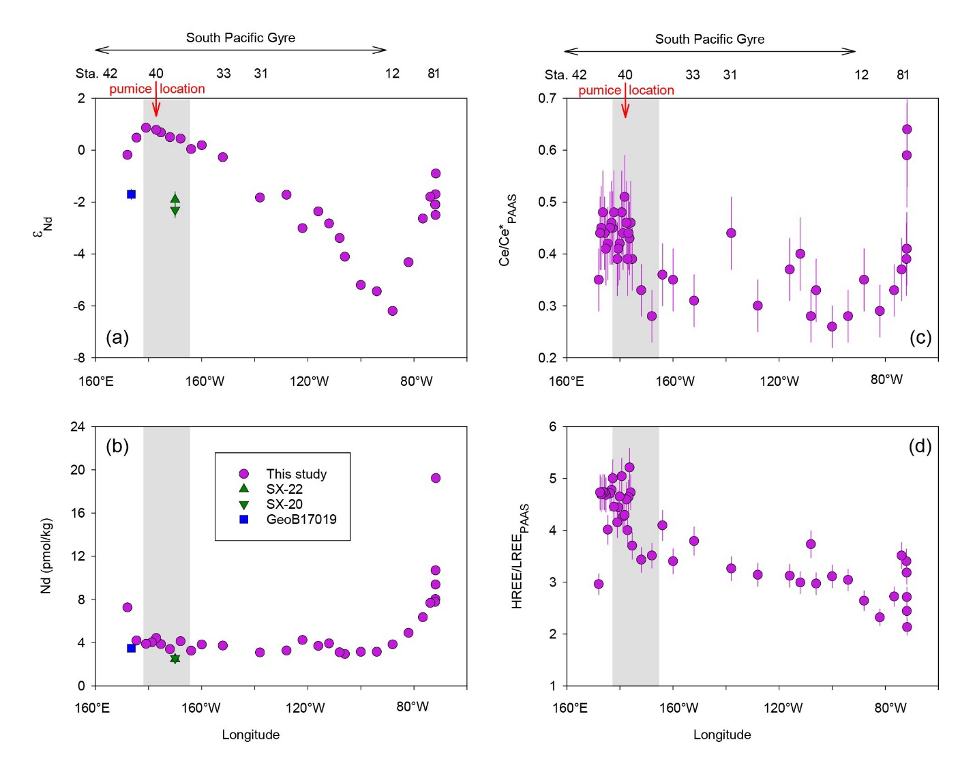
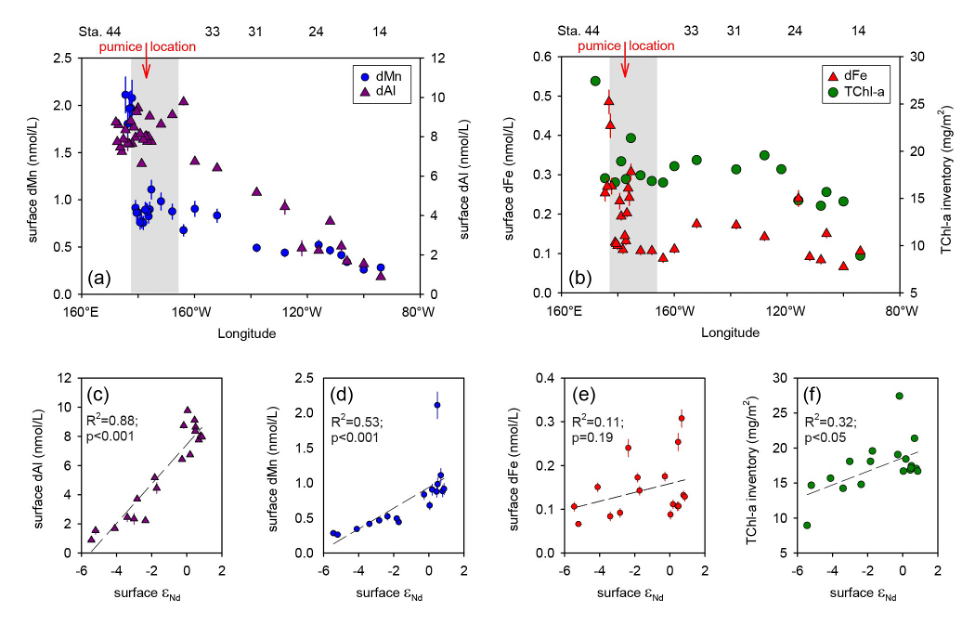
Zhang and co-workers (2024, see reference below) investigate the impact of the 2022 HTHH eruption on the biogeochemistry of the South Pacific Gyre (SPG) surface waters using field observations made on an across-Pacific expedition (GEOTRACES GP21) starting one month after the eruption. Using radiogenic neodymium isotopes and rare earth element concentrations, they are able to fingerprint a marked volcanic impact on the western SPG, the region identified as the primary site of post-eruption deposition based on a volcanic ash dispersal model. This impact may extend to regions further east via atmospheric ash dispersal and surface current transport. They also demonstrate a coincident enhancement of trace metal and chlorophyll-a concentrations in surface waters providing evidence for a stimulation of biological activity in response to eruption-derived micronutrient inputs. They estimate that the iron release from the HTHH eruption (32±8 kt) was comparable to the amount of iron fertilization from the giant eruption of Mount Pinatubo in June 1991 (40 kt), which was associated with atmospheric carbon/oxygen anomalies.
This finding offers new insights into the impacts of major volcanic eruptions on oceanic biogeochemistry, with implications for nutrient cycling and ecosystem dynamics in the SPG and beyond.
Reference:
Zhang, Z., Xu, A., Hathorne, E., Gutjahr, M., Browning, T.J., Gosnell, K.J., Liu, T., Steiner, Z., Kiko, R., Yuan, Z., Liu, H., Achterberg, E.P., Frank, M., 2024. Substantial trace metal input from the 2022 Hunga Tonga-Hunga Ha’apai eruption into the South Pacific. Nat Commun 15, 8986. Access the paper: https://doi.org/10.1038/s41467-024-52904-3