
Seasonal iron supply in the Southern Ocean is dominated by winter mixing
An international team of researchers analysed the available dissolved iron data taken from all previous studies of the Southern Ocean, together with satellite images taken of the area, to quantify the amount of iron supplied to the surface waters of the Southern Ocean. They found that in contrast to the processes that supply so-called macronutrients in the tropics, seasonal iron supply is dominated by winter mixing with little iron input afterwards. This is because the vertical profile of iron is distinct from other nutrients, with subsurface reserves located much deeper in the water column and therefore only accessible by the deeper mixing that occurs in winter. This means that after this input pulse, intense iron recycling by the ‘ferrous wheel’ is necessary to sustain biological activity. This unique aspect of iron cycling is yet to be explained but places important constraints on how climate models represent the iron distribution and how changes in ocean physics impact iron limitation.
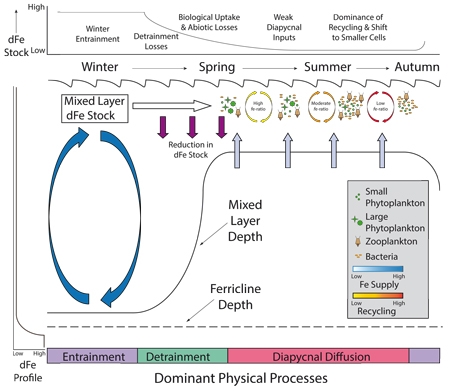
Figure. This diagram represents the seasonal variability in Southern Ocean iron (Fe) cycling. Click here to view the figure larger.
References:
Tagliabue, A., Sallée, J.-B., Bowie, A. R., Lévy, M., Swart, S., & Boyd, P. W. (2014). Surface-water iron supplies in the Southern Ocean sustained by deep winter mixing. Nature Geoscience, 7(4), 314–320. doi:10.1038/ngeo2101 Click here to view the paper.