
Regional zinc cycling in the Indian Ocean
Using an extensive database of dissolved Zn (dZn) from multiple GEOTRACES-India section cruises, Chinni and his colleagues (2025, see reference below) has presented the dZn distribution in the Arabian Sea (AS), Bay of Bengal (BoB) and southern tropical Indian Ocean (STIO). Continental shelf inputs are the major Zn sources for the photic waters of the northern Indian Ocean, while soluble atmospheric dust input areis negligible. Thanks to a multiparametric analysis of the water masses, they demonstrated that water mass mixing and scavenging are the primary mechanisms controlling dZn distribution in the region. A strong linear relationship between dZn and silicate is observed everywhere but shows variable slopes, steeper in the STIO than in the BoB and AS. These variations reflect dominant Zn scavenging in the low-oxygen waters of the Indian Ocean.
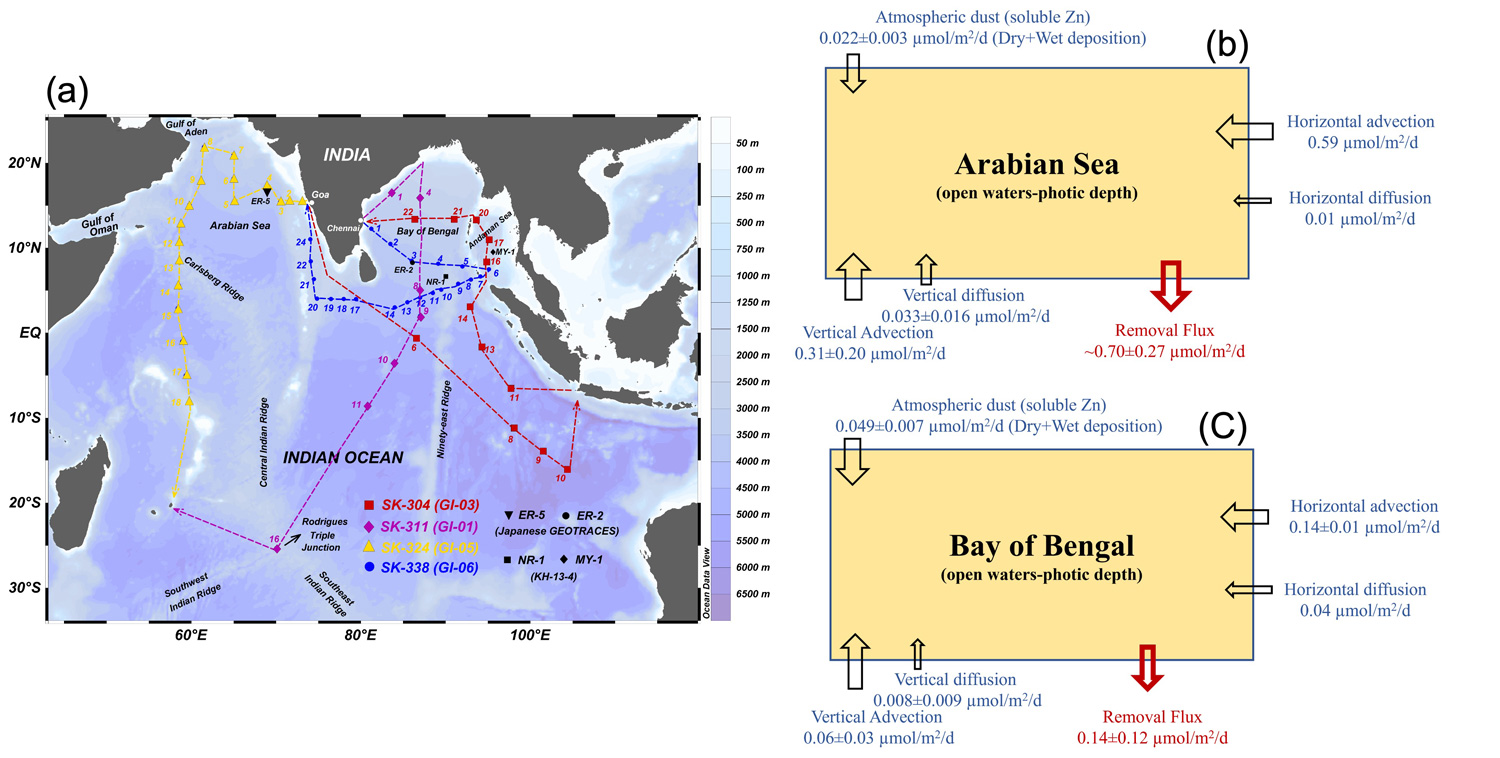
Right panel: Approximated geochemical budget of dissolved zinc in photic waters (top 100 m) of northern Indian Ocean: (b) the Arabian Sea and (c) the Bay of Bengal. The removal flux mentioned in the figure represents the total removal fluxes (both biotic and abiotic).
Reference:
Chinni, V., Singh, N. D., Singh, S. K., & Goswami, V. (2025). Biogeochemical cycling of dissolved zinc in the Indian Ocean. Limnology and Oceanography. Access the paper:10.1002/lno.70286