
Rare Earth Elements and neodymium isotopes as tracers in the Mediterranean Sea
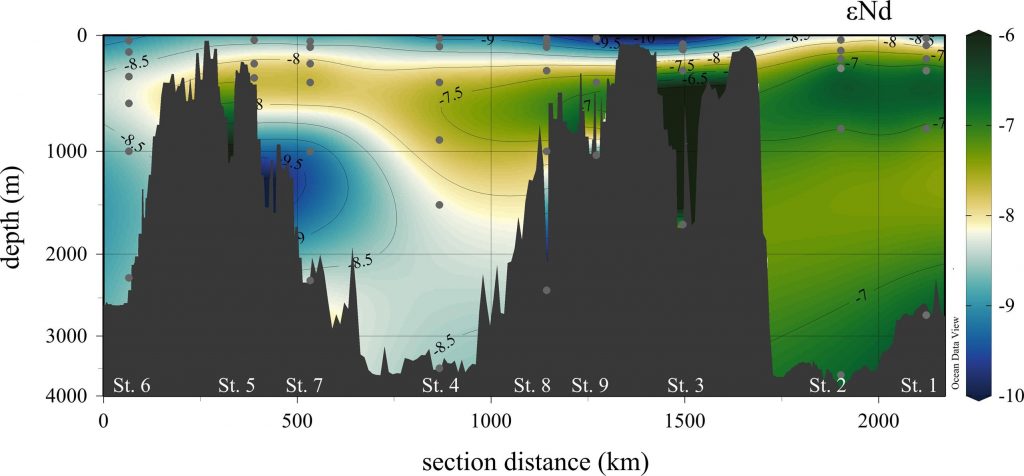
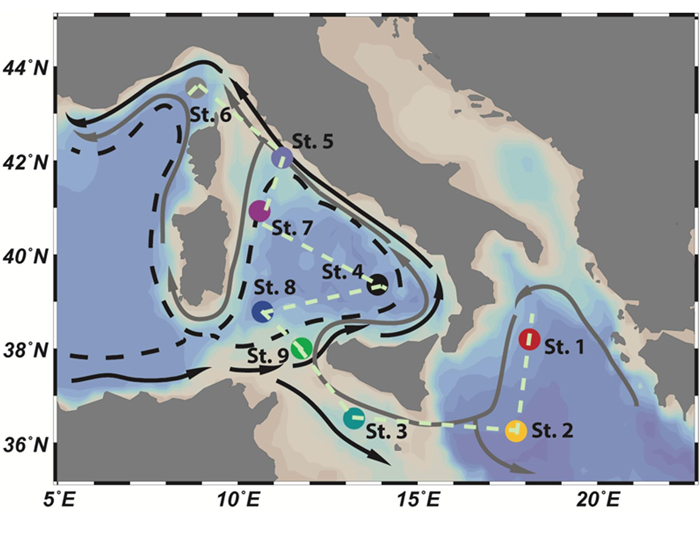
Garcia-Solsona and co-workers (2020, see reference below) analysed 9 seawater stations around the central Mediterranean Sea (MS) to clarify the relative importance of external sources, vertical (biogeochemical) processes and lateral water mass transport in controlling Rare Earth Elements (REE) and neodymium isotopic composition (εNd) distributions.
Their results clearly identify the influence of continental input from the western Italian coast to the Tyrrhenian surface waters, marked by a negative correlation of surface light REE enrichment with offshore distance.
Contrastingly, a reasonable conservative behaviour of heavy REE and εNd is observed in the Central MS. This contrast induces a decoupling of [Nd] and εNd in all water masses of the central MS below the thermocline.
The conservativity of heavy REE and εNd as water mass mixing tracers was successfully established using an Optimum Multi-Parameter Analysis (OMPA) and confirming that the distributions of heavy REE and εNd signals are determined by mixing of the water masses present in the region: Modified Atlantic Water (MAW), Levantine Intermediate Water (LIW), Eastern Mediterranean Deep Water (EMDW) and Western Mediterranean Deep Water (WMDW). From their results, authors further suggest that εNd helps traditional oceanographic tracers in better defining the intrusion of EMDW through the Strait of Sicily to the western Mediterranean basin.
Reference:
Garcia-Solsona, E., Pena, L. D., Paredes, E., Pérez-Asensio, J. N., Quirós-Collazos, L., Lirer, F., & Cacho, I. (2020). Rare earth elements and Nd isotopes as tracers of modern ocean circulation in the central Mediterranean Sea. Progress in Oceanography, 185, 102340. DOI: https://doi.org/10.1016/J.POCEAN.2020.102340