
Precise estimate of the mercury export from the Arctic to the Atlantic Ocean
The Fram Strait is the only deep connection between the Arctic and Atlantic Oceans. Several mercury (Hg) mass balance studies hinted a net export from the Arctic to the Atlantic Ocean. However, in the absence of observations at Fram Strait these estimates had to be based on many assumptions. Using new observations acquired during the 2015 GEOTRACES (section GN04) TransArcII cruise to the Barents Sea Opening and the 2016 GEOTRACES (section GN05) GRIFF cruise, to the Fram Strait and Northeast Greenland Shelf, a refined arctic Hg budget was established. The Hg concentrations in the East Greenland Current (EGS 1.29 ± 0.43 pM) were higher, compared to the West Spitsbergen Current (WSC 0.80 ± 0.26 pM), resulting in a northward flow of 43±9 Mg y−1 and a southward flow of 54±13 Mg y−1 at Fram Strait. The updated arctic Hg mass balance shows that the Arctic Ocean exports about 18 Mg y−1 Hg to the Atlantic Ocean, 40% of which is in the form of methylmercury.
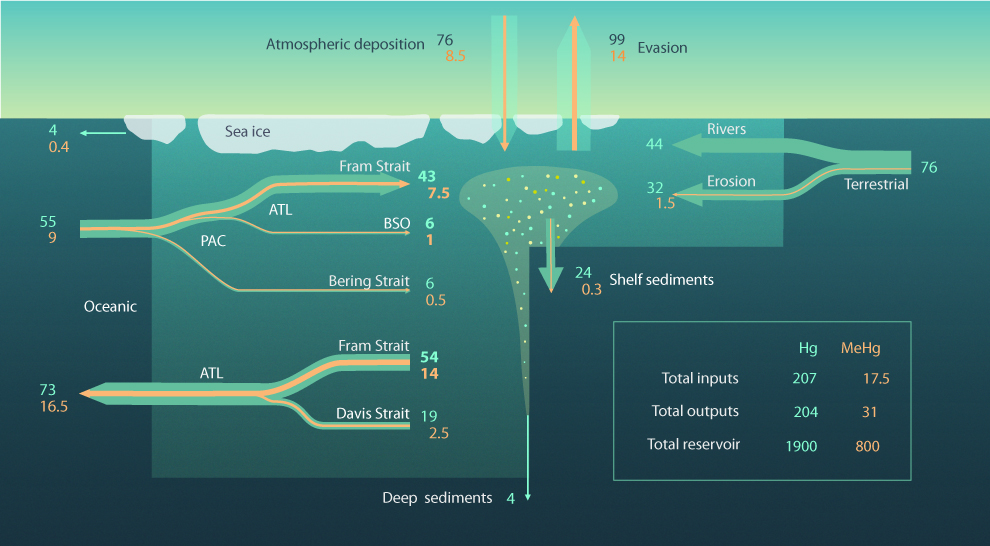
Reference:
Petrova, M. V.; Krisch, S.; Lodeiro, P.; Valk, O.; Dufour, A.; Rijkenberg, M. J. A.; Achterberg, E. P.; Rabe, B.; van der Loeff, M. R.; Hamelin, B.; Sonke, J.E., Garnier, C.; Heimbürger-Boavida, L.E. Mercury Species Export from the Arctic to the Atlantic Ocean. Mar. Chem. 2020, 103855. DOI: https://doi.org/10.1016/j.marchem.2020.103855