
A better insight into parameters that control particle flux in the ocean
Estimating how fast particles sink and the magnitude of particle flux can help us better understand the cycling of elements in the ocean, including carbon. Xiang and his colleagues (2022, see reference below) compiled full ocean-depth size-fractionated (1–51 and >51 μm) particle concentration and composition data from three recent U.S. GEOTRACES cruises (GA03, GP16 and GN01) and combined these measurements with estimates of particle porosity to estimate sinking speeds and particle flux. This Stokes’ Law-based strategy exploits detailed information on particle characteristics and allows the comparison of 3 different geochemical environments: the North Atlantic, Eastern Tropical South Pacific, and Western Arctic Ocean. Results of this original detailed study of the particle speciation and fluxes reveal that many factors, such as the chemical composition and size of marine particles and viscosity of seawater compete for influence: although mineral phases, characterized by higher densities, provide excess weight to enhance particle flux, other factors such as particle size and seawater viscosity were more influential for explaining differences in sinking speeds and thereby flux between the three cruises. For example, in the high-latitude Arctic Ocean, marine particles have high concentrations of ballasting minerals; this alone, however, cannot outcompete the most viscous water, smallest particle size and concentrations, leading to much smaller mass fluxes compared to tropical oceans.
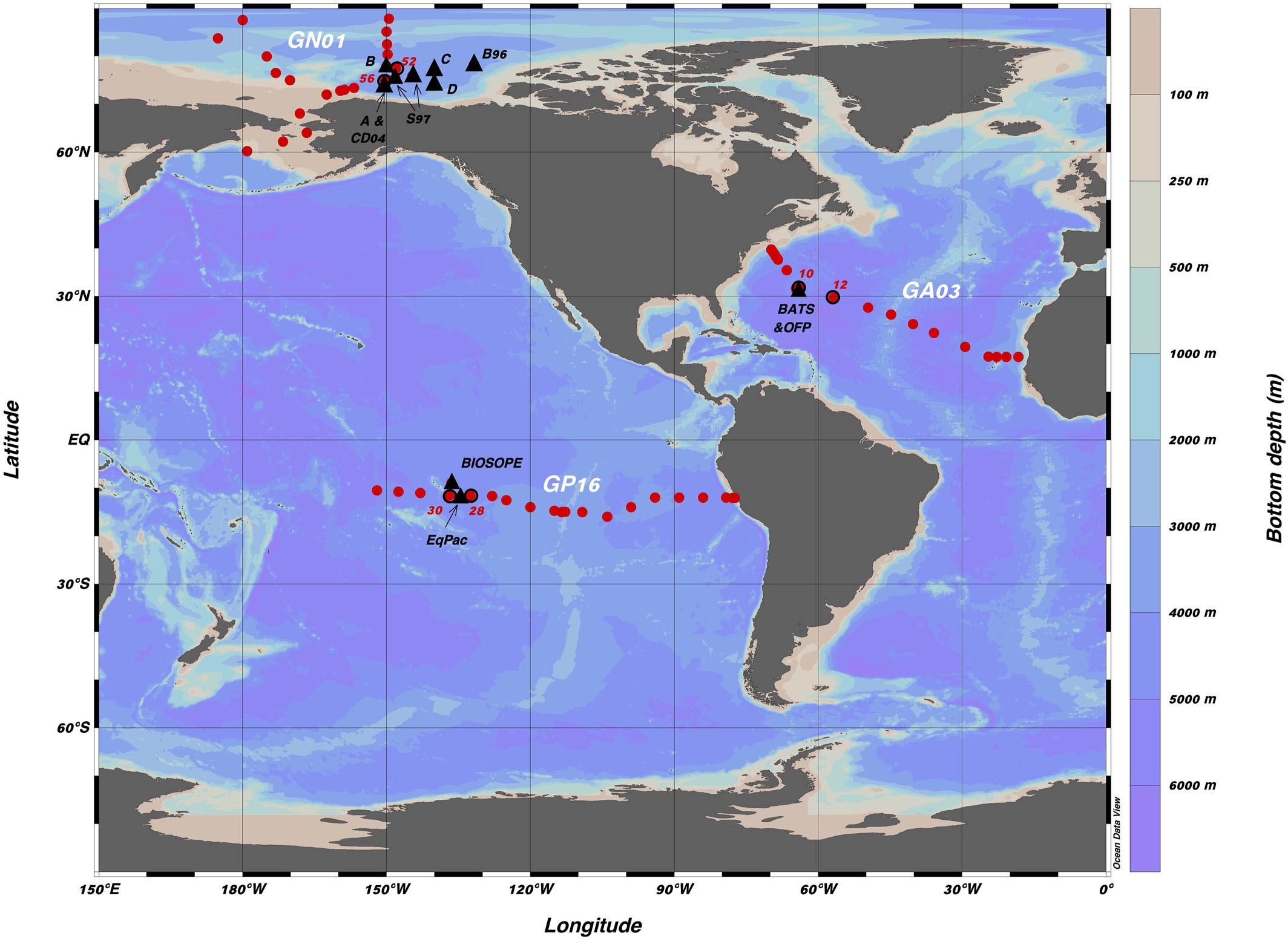
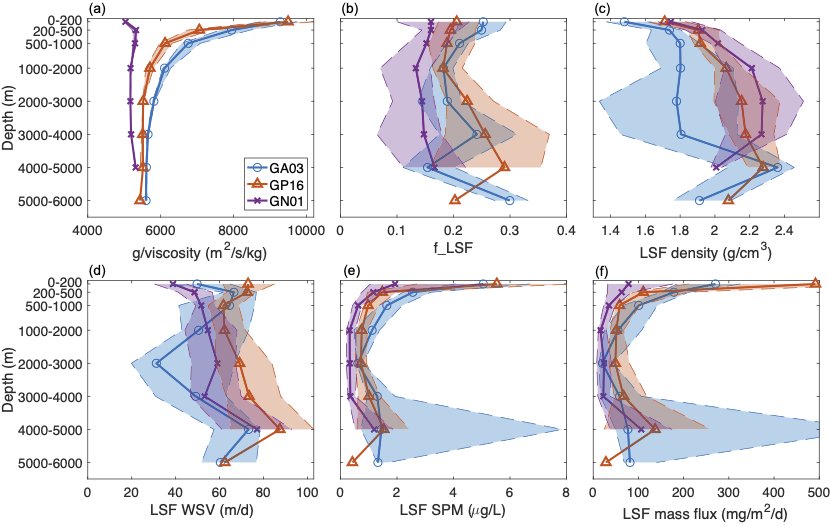
Figure: On the top, is a map of three U.S. GEOTRACES cruises in which in-situ pumps were deployed (red dots). The bottom figure illustrates depth-binned profiles of Stokes-Law-associated parameters and estimated sinking velocity and mass flux of large particles (>51 μm) in gyre stations in the North Atlantic (GA03), Eastern Tropical South Pacific (GP16), and Western Arctic Ocean (GN01) cruises. The median of each parameter (solid lines) demonstrates the typical profile in the three cruises, and the interquartile range (coloured shades) reflects the variability. The decomposition of different aspects of the Stokes’ relationship (seawater viscosity η (g/viscosity), particle size (f_LSF) and density) and of the mass flux (average particle sinking velocity (LSF WSV) and particle concentration (LSF SPM)) shed light on lower mass flux attenuation in the North Atlantic cruise compared to the Pacific cruise and the lowest total mass flux in the Western Arctic Ocean cruise.
Reference:
Xiang, Y., Lam, P. J., Burd, A. B., & Hayes, C. T. (2022). Estimating Mass Flux from Size‐Fractionated Filtered Particles: Insights into Controls on Sinking Velocities and Mass Fluxes in Recent U.S. GEOTRACES Cruises. Global Biogeochemical Cycles, 36(4). Access the paper:10.1029/2021gb007292