
Paradoxical influence of hydrothermal methylmercury on local ecosystems

Torres Rodríguez and her colleagues (2025, see reference below) investigate hydrothermal mercury inputs at the Tonga volcanic arc and their impact on local surface ocean ecosystems. Although they identified high mercury fluxes (4,763 pmol m⁻² day⁻¹) reaching productive surface waters, they found that mercury concentrations in phytoplankton remain unexpectedly low. In fact, natural iron fertilisation from hydrothermal sources stimulates intense phytoplankton blooms, which dilute mercury at the cellular level and reduce the impact of hydrothermal mercury. The authors also provide a revised global estimate of hydrothermal mercury inputs, with a maximum of 120 t yr⁻¹—considerably lower than anthropogenic emissions.

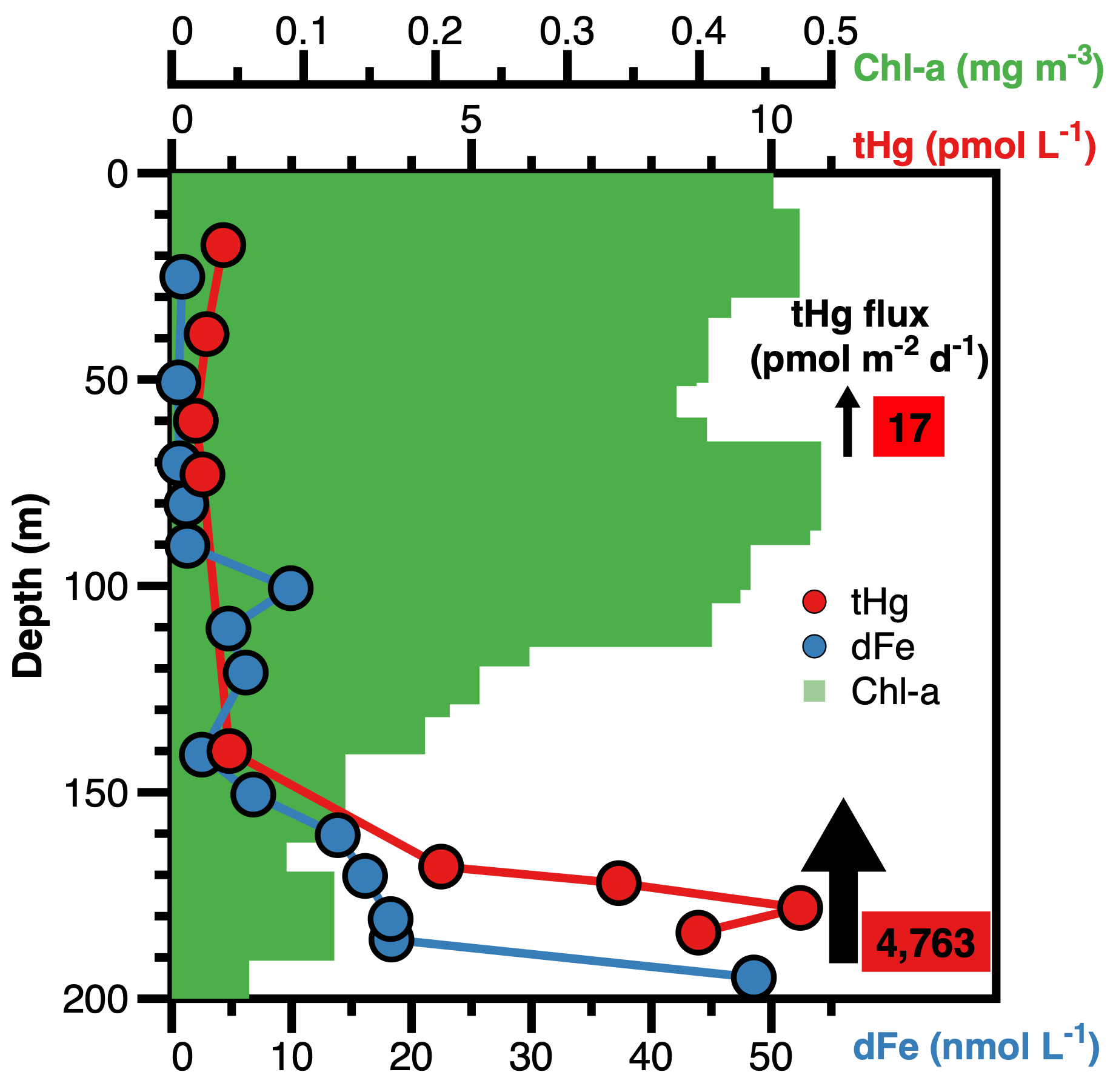
Figure 1: The authors use a combination of water column, phytoplankton, sediment trap, and sediment core observations of Hg species and stable isotopes to investigate the fate of mercury inputs released from the Tonga Arc (fluxes in pmol m-2 d-1).
Figure 2: Hydrothermal inputs at the Panamax volcano of the Tonga Arc. Hydrothermal mercury (Hg) and iron (Fe) concentrations and fluxes from the volcano at 200 m depth generate a low Hg phytoplankton bloom (chlorophyll-a) in the overlying waters.

Reference:

Torres-Rodriguez, N., Yuan, J., Dufour, A., Živković, I., Point, D., Boulart, C., Knoery, J., Horvat, M., Amouroux, D., Bonnet, S., Guieu, C., Sun, R., & Heimbürger-Boavida, L.-E. (2025). Natural Iron Fertilization Moderates Hydrothermal Mercury Inputs from Arc Volcanoes. Environmental Science &Amp; Technology59, 11039–11050. Access the paper:10.1021/acs.est.5c01767

Latest highlights

Major controls on the fate of dissolved manganese in the northeastern Indian Ocean

Malla and Singh investigated the key factors controlling dissolved manganese in the northeastern Indian Ocean.

An original approach to assess the particulate trace metal concentrations in seawater

Sohrin and co-workers propose defining particulate trace metal as the difference between total dissolvable and dissolved metals after a long storage of filtered and unfiltered acidified seawater.

Constraining aerosol deposition over the global ocean by the cosmogenic beryllium-7

He and co-workers propose a global estimate of aerosol deposition onto the ocean using the cosmogenic radionuclide beryllium-7.

Oceanic lead concentrations and isotopes mapped using explainable machine learning

Using three machine learning models, Olivelli and her colleagues generated global climatologies of lead concentrations and isotopes…

Rechercher