
Neodymium isotopes trace past Antarctic Intermediate Water circulation in the Arabian Sea
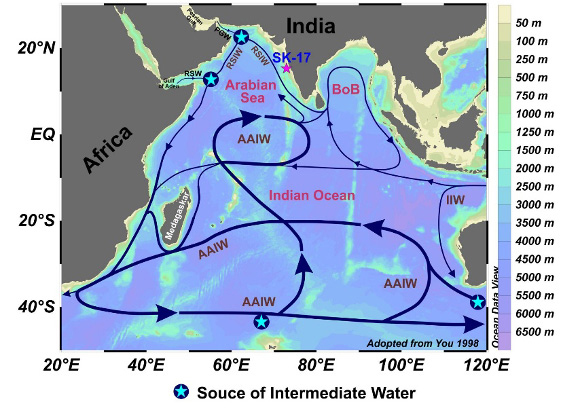
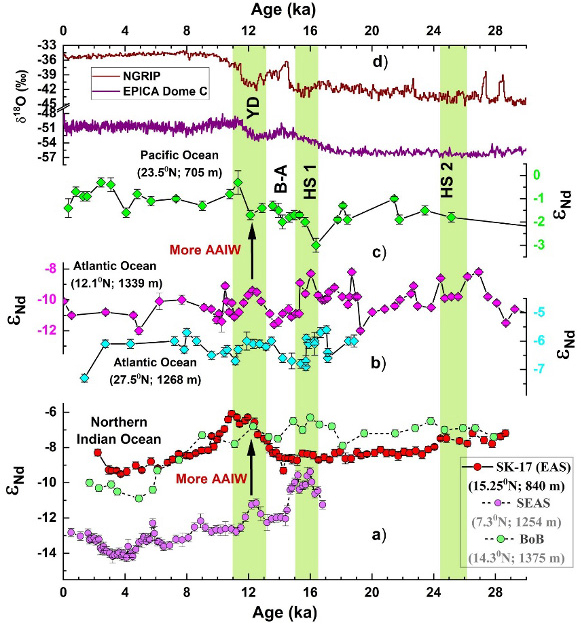
In paleoclimatology, Younger Dryas (YD, 12ka BP) and Heinrich Stadials (HS1, 16 ka BP and HS2, 25 ka BP) are identified as very cold events at the end of the Last Glacial Maximum (LGM). The potential shutdown of the North Atlantic Deep Water (NADW or its glacial equivalent) during these events might have impacted the dynamics of the Antarctic Intermediate Water (AAIW), which is one of the main actors ventilating the Arabian Sea. Reconstructing this ventilation in the North West Indian Ocean was the goal of Shukla and co-authors (2026, see reference below). To tackle this issue, the authors measured at high resolution the neodymium (Nd) isotopic composition (over the last ~29 ka, expressed as eNd) on the authigenic and silicate phases of sediments from a core collected off Goa. They revealed a pronounced temporal variation (-9.5 to -6.1) throughout the core, marked by an enhanced radiogenic Nd signature during the YD, HS1, and HS2. The more radiogenic Nd signatures reflect an increase in the northward penetration of AAIW into the Northern Indian Ocean. Their interpretation is that when the Atlantic Meridional Overturning Circulation (AMOC) was decelerating, the formation of AAIW in the Southern Ocean increased. Last but not least, their data are consistent with Atlantic and Pacific past circulation reconstructions.
Reference:
Shukla, A., Mishra, T. K., Singh, S. K., & Singh, A. D. (2025). Substantial invasion of Antarctic Intermediate Water into the Arabian Sea during Younger Dryas and Heinrich Stadials. Quaternary Science Reviews, 349, 109115. Access the paper: 10.1016/j.quascirev.2024.109115