
Long distance dissolved iron transport in the North-East Pacific revealed by multiple tracers and an ocean circulation model
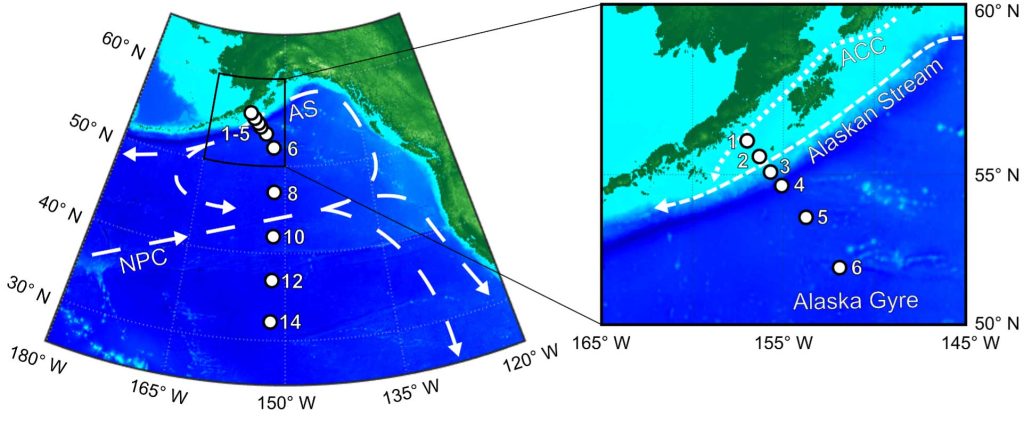
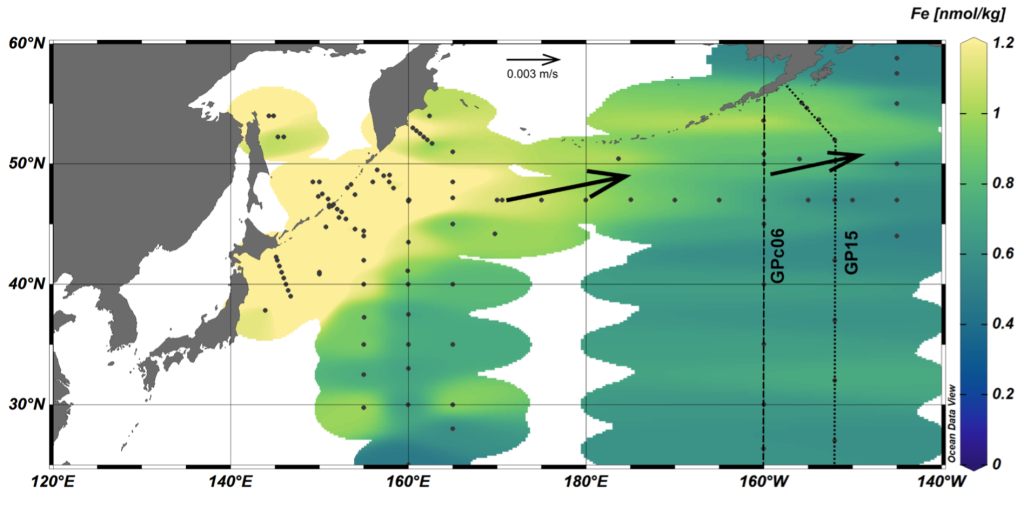
GEOTRACES strategy is to combine the information provided by different geochemical tracers to identify and quantify oceanic processes. Sieber and co-authors (2024, see reference below) have made extensive use of this multi-tracer approach, coupled to an oceanic circulation model. By measuring sediment‐source tracers including dissolved iron isotope composition (δ56Fe), manganese (Mn), radium-228 (228Ra), and particulate iron (Fe), they revealed the dissolved Fe provenance of three dissolved iron plumes identified close to the Alaskan continental margin: surprisingly, while two originate from local shelf and abyss sedimentary sources, the intermediate depth dissolved Fe plume results not from the local margin but instead from long‐distance transport of dissolved iron from Asian marginal sediment sources. This finding extends work that already has shown the large eastward transport of Fe from Asian marginal seas into the North Pacific.
Reference:
Sieber, M., Lanning, N. T., Steffen, J. M., Bian, X., Yang, S.-C., Lee, J. M., Weiss, G., Hunt, H. R., Charette, M. A., Moore, W. S., Hautala, S. L., Hatta, M., Lam, P. J., John, S. G., Fitzsimmons, J. N., & Conway, T. M. (2024). Long Distance Transport of Subsurface Sediment‐Derived Iron From Asian to Alaskan Margins in the North Pacific Ocean. Geophysical Research Letters, 51. Access the paper: 10.1029/2024gl110836