
Linking cadmium cycling to phosphate dynamics in the Indian Ocean: Evidence from GEOTRACES transects
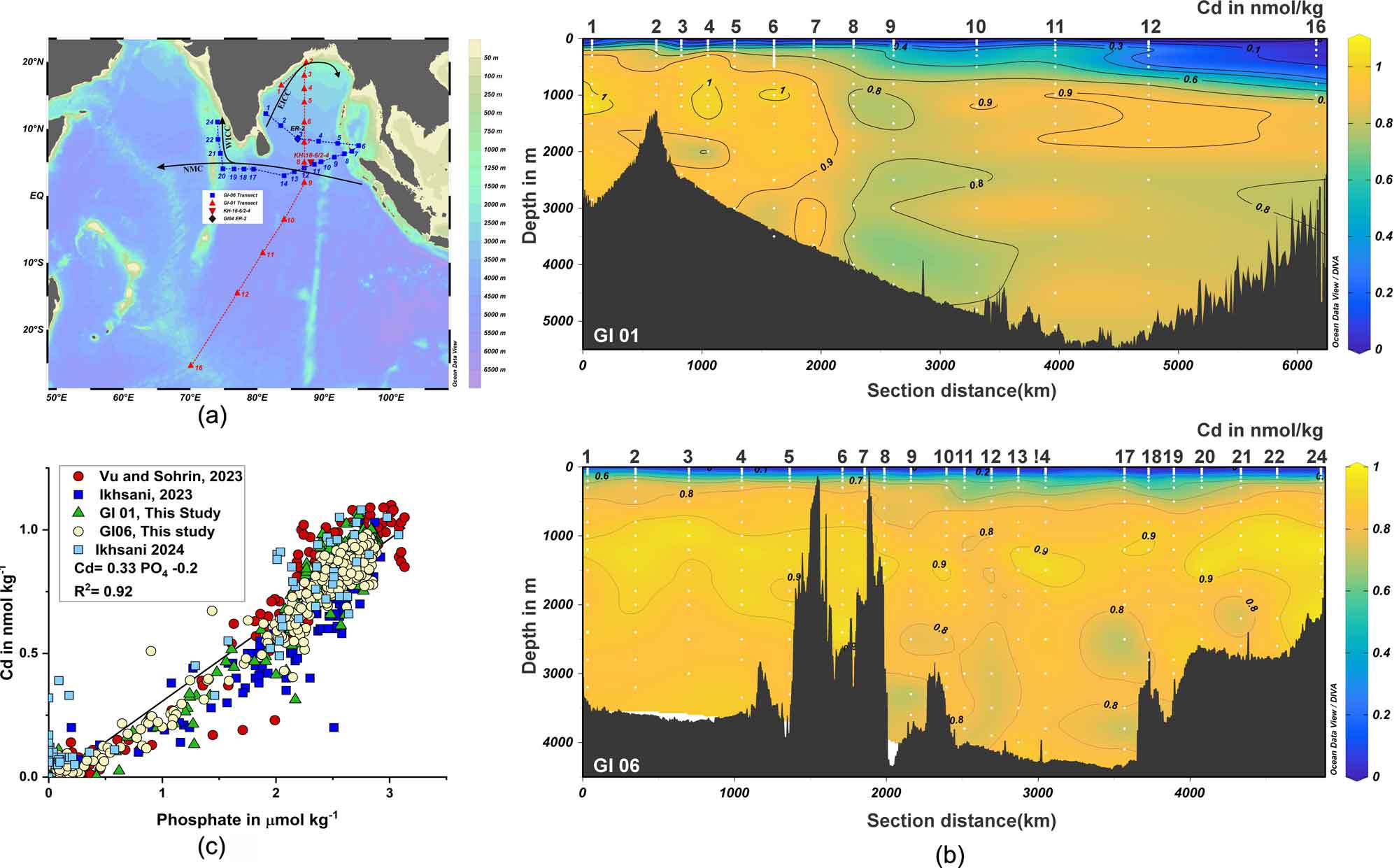
Mishra and Singh (2025; see reference below) determined cadmium (Cd) and phosphate (PO₄) concentrations along 34 complete vertical profiles collected during the GEOTRACES cruises GI01 and GI06. Across these meridional and zonal transects, which span the northeastern Indian Ocean—including the southeastern Arabian Sea and the subtropical gyre region of the Indian Ocean—they observed:
- A pronounced north–south decreasing gradient in surface dissolved cadmium (dCd) was observed, suggesting the combined influence of riverine and atmospheric inputs to the Bay of Bengal (BoB).
- Surface waters at stations south of the equator display very low dCd, even below the detection limit in the oligotrophic subtropical gyre.
- Vertical profiles of dCd along the GI01 and GI06 transects show a nutrient-like distribution, similar to that of the macronutrient phosphate.
- In surface waters with excess dissolved iron (dFe), a low Cd/PO₄ ratio was observed below the chlorophyll‑a maxima, likely resulting from the preferential uptake of Cd over phosphate by phytoplankton, independent of iron availability.
- In the highly diatom-productive region of the BoB, higher dCd was observed in oxygen-deficient intermediate waters compared to the other stations, due to the regeneration of Cd-rich particulate organic carbon (POC).
- Hydrothermal vents appeared to have little or no impact on the global Cd budget.
Based on all published dCd data in the Indian Ocean, including the present study, the overall slope of the Indian Ocean Cd–PO₄ cross plot is approximately 0.33 nmol μmol⁻¹, which is well correlated with the global ocean slope.
Reference:
Mishra, T. K., & Singh, S. K. (2025). Water Column Cycling of Cadmium in the North‐Eastern and Subtropical Gyre Region of the Indian Ocean. Journal of Geophysical Research: Oceans, 130. Access the paper:10.1029/2025jc022817
Ikhsani, I. Y., Wong, K. H., Kim, T., Mashio, A. S., Norisuye, K., & Obata, H. (2024). Biogeochemistry of dissolved trace metals in the Bay of Bengal. Marine Chemistry, 104394. Access the paper: 10.1016/j.marchem.2024.104394
Ikhsani, I. Y., Wong, K. H., Ogawa, H., & Obata, H. (2023). Dissolved trace metals (Fe, Mn, Pb, Cd, Cu, and Zn) in the eastern Indian Ocean. Marine Chemistry, 248, 104208. Access the paper: 10.1016/j.marchem.2023.104208
Thi Dieu Vu, H., & Sohrin, Y. (2013). Diverse stoichiometry of dissolved trace metals in the Indian Ocean. Scientific Reports, 3(1), 1745. Access the paper: 10.1038/srep01745