
How to constrain the biogeochemical cycle of cobalt in the surface Western Atlantic Ocean?
Cobalt (Co) is an important micronutrient for many species living in the surface waters (bacteria, cyanobacteria, different types of phytoplancton…). Interestingly, the Co requirements vary between the different species and these variations are influencing the dissolved Co distribution in the surface waters. This is clearly demonstrated by the set of data published by Dulaquais and co-authors (2014, see reference below) along a GEOTRACES north-south section in the western Atlantic Ocean (GA02). This work also shows that recycling sustains the biological requirement for cobalt in subtropical domains, and that both atmospheric and Amazon inputs affect the Co distribution.
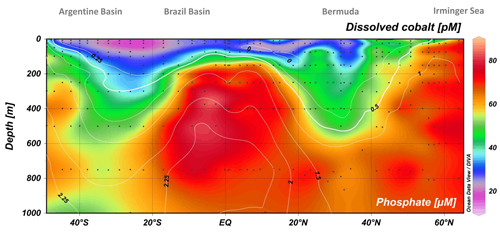
Figure: Interpolated concentrations of dissolved cobalt overlaid with phosphate (µM; white contours) in the upper 1000 m of the West Atlantic during the GA02 section. Click here to view the figure larger.
Reference:
Dulaquais, G., Boye, M., Middag, R., Owens, S., Puigcorbé, V., Buesseler, K., Masqué, P., de Baar, H., Carton, X. (2014). Contrasting biogeochemical cycles of cobalt in the surface western Atlantic Ocean. Global Biogeochemical Cycles, 28(12), 1387–1412. doi:10.1002/2014GB004903 Click here to access the paper.