
Exhaustive study discussing ocean marine carbon dioxide removal via iron fertilization
In order to restrict the global warming to 1.5 °C, it is necessary to remove, before the year 2100, up to 1000 Gt of atmospheric carbon dioxide (CO2), in addition to huge emission reduction efforts. Today, there is renewed interest in ocean iron fertilization (OIF) for large-scale carbon dioxide removal (CDR) operations and OIF is still a widely considered method within the marine method CDR portfolio.
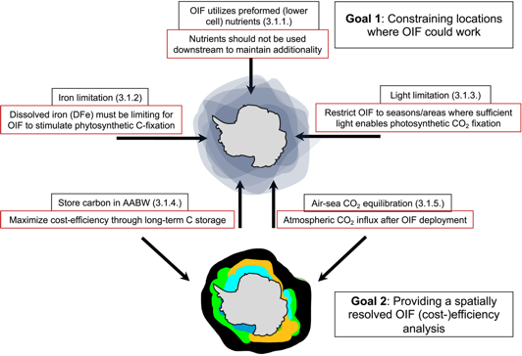
The analysis presented by Bach and his colleagues (2023, see reference below) considers different biogeochemical variables that affect the CDR efficiency of OIF: (a) to use preformed nutrients from the lower overturning circulation cell; (b) for prevailing iron-limitation; (c) for sufficient underwater light for photosynthesis; (d) for efficient carbon sequestration; (e) for sufficient air-sea CO2 transfer.
Instead of biogeochemical modelling, their approach favours to use a range of observational, experimental, and computational data sources to assemble the necessary information and compile it in equations to derive estimates of OIF cost-efficiency. In other words, these 5 criteria were assessed consecutively and finally synthesized into spatially resolved costs per tonne of CO2 removed.
Their findings on (cost-)efficiency provide little incentive to further explore OIF in the open Southern Ocean south of 60°S, except perhaps some Antarctic shelf regions (e.g., Ross Sea shelf), where the CDR costs can be <100 US$/tonne CO2 while they are mainly >>1,000 US$/tonne CO2 in offshore regions of the Southern Ocean. However, even if future research confirmed a high (cost-)efficiency on Antarctic shelves, it raises legal questions because regions close to Antarctica fall under three overlapping (and environmentally protective) layers of international law.
Reference:
Bach, L. T., Tamsitt, V., Baldry, K., McGee, J., Laurenceau‐Cornec, E. C., Strzepek, R. F., Xie, Y., & Boyd, P. W. (2023). Identifying the Most (Cost‐)Efficient Regions for CO2 Removal with Iron Fertilization in the Southern Ocean. Global Biogeochemical Cycles, 37. doi:10.1029/2023gb007754