
Environmental changes in the Arctic Ocean are occurring now!
This is what reveals the first full transarctic section of radium-228 (228Ra) in surface waters measured during Arctic cruises along GEOTRACES transects GN04 (cruise PS94) and GN01 (cruise HLY1502) proposed by Rutgers van der Loeff and colleagues (2018, see reference below). 228Ra activities in the central Arctic have increased from 2007 through 2011 to 2015 (Kipp, et al. 2018), reflecting increased 228Ra input attributed to stronger wave action on shelves resulting from a longer ice-free season (in other words to climate change). However, the authors are going further, associating thorium-228, iodine-129, SF6, thorium-234 and polonium-210 data to their own Ra results to better disentangle the vertical (mostly biogenic) from the advected fluxes. They estimate a ventilation time of 480 years for the deep Makarov-Canada Basin, in good agreement with previous estimates using other tracers.
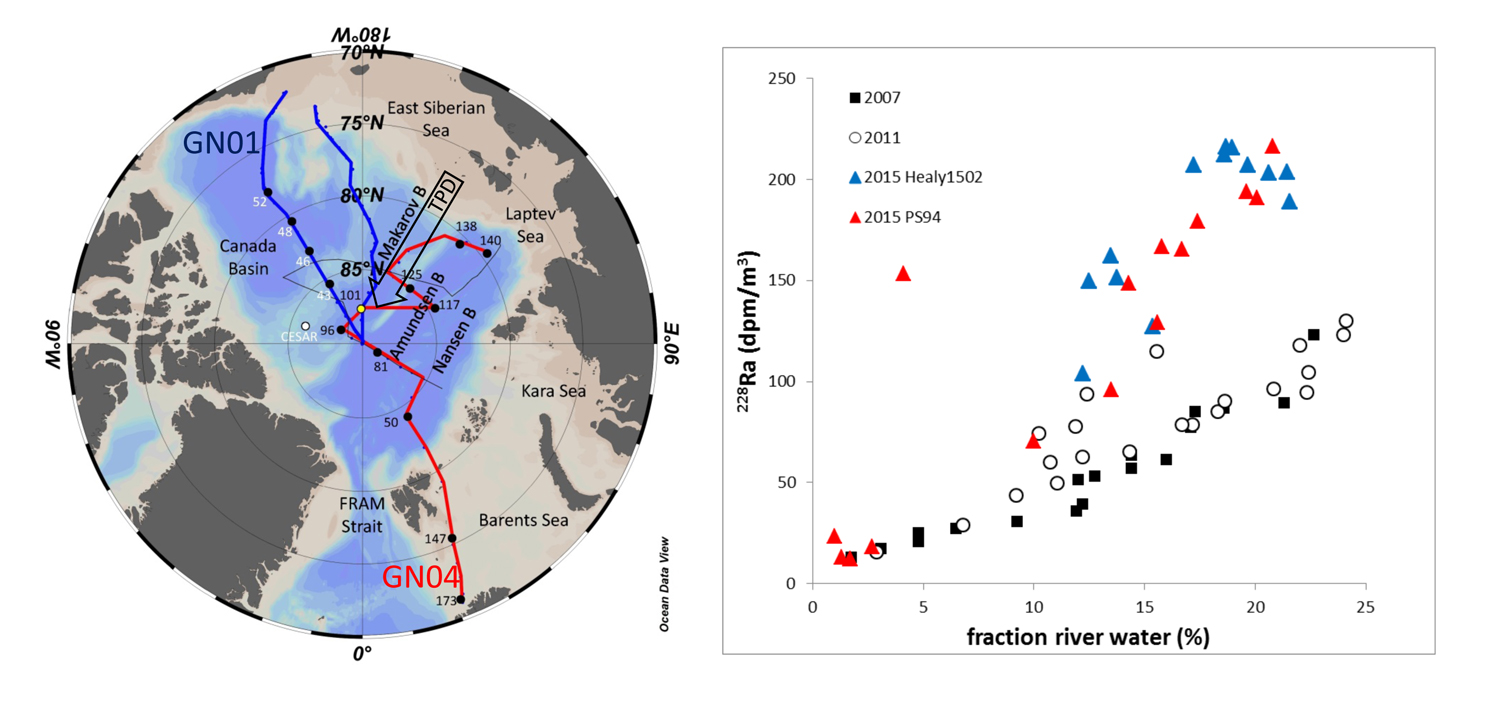
Figure: Two GEOTRACES expeditions in 2015 provided together a full section across the Arctic Ocean, crossing in surface waters the Transpolar Drift (TPD) identified by the high fraction of river water derived from Siberian rivers. 228Ra is added to the TPD from the sediments on the wide Siberian shelves. 228Ra data in surface waters measured on Healy (GN01, blue) and Polarstern (GN04, red) are in good agreement and show that 228Ra in the TPD has about doubled since earlier sections in 2011 (black circles, track in black) and 2007 (GIPY11, black squares, track not shown). Click here to view the figure larger.
Reference:
Rutgers van der Loeff, M., Kipp, L., Charette, M. A., Moore, W. S., Black, E., Stimac, I., Charkin, A., Bauch, D., Valk, O., Karcher, M., Krumpen, T., Casacuberta, N., Rember, R. (2018). Radium Isotopes Across the Arctic Ocean Show Time Scales of Water Mass Ventilation and Increasing Shelf Inputs. Journal of Geophysical Research: Oceans, 123(7), 4853–4873. DOI : http://doi.org/10.1029/2018JC013888
Kipp, L.E., Charette, M.A., Moore, W.S., Henderson, P.B., Rigor, I.G., 2018. Increased fluxes of shelf-derived materials to the central Arctic Ocean. Science Advances 4, DOI: http://dx.doi.org/10.1126/sciadv.aao1302
You can also read the EOS.org magazine Editors’ highlight “Increased Release Rates of Radium Isotopes on Arctic Shelves”: https://eos.org/editor-highlights/increased-release-rates-of-radium-isotopes-on-arctic-shelves