
Dissolved nickel sources: transformation and sinks in the Arabian Sea

Malla and co-authors (2025, see reference below) present an extensive study of the distribution of dissolved nickel (dNi) in the Arabian Sea. Concentrations range from ∼2 nM at the surface to ∼12 nM in deeper waters, showing a typical nutrient-like profile. Based on their estimates of three major external sources, authors show that atmospheric dust accounts for ~36% of the dNi supply, while riverine input and submarine groundwater discharge (SGD) contribute ~62% and ~2%, respectively.

The vertical distribution of dNi reflects the combined influence of these external inputs, water-mass mixing, biological uptake and remineralization, as well as reversible scavenging. Above 1000 m, scavenging dominates; below 1000 m, regeneration seems to be the main process (see figure).

Last but not least, there are Oxygen Minimum Zones (OMZs) in the Arabian Sea. Interestingly, a significant depletion of dNi over Phosphate in the intense oxygen minimum is observed, implying a complex interplay of factors such as nickel loss as sulphides or iron oxides or particulate organic carbon (POC) and due to varying ecosystem composition.
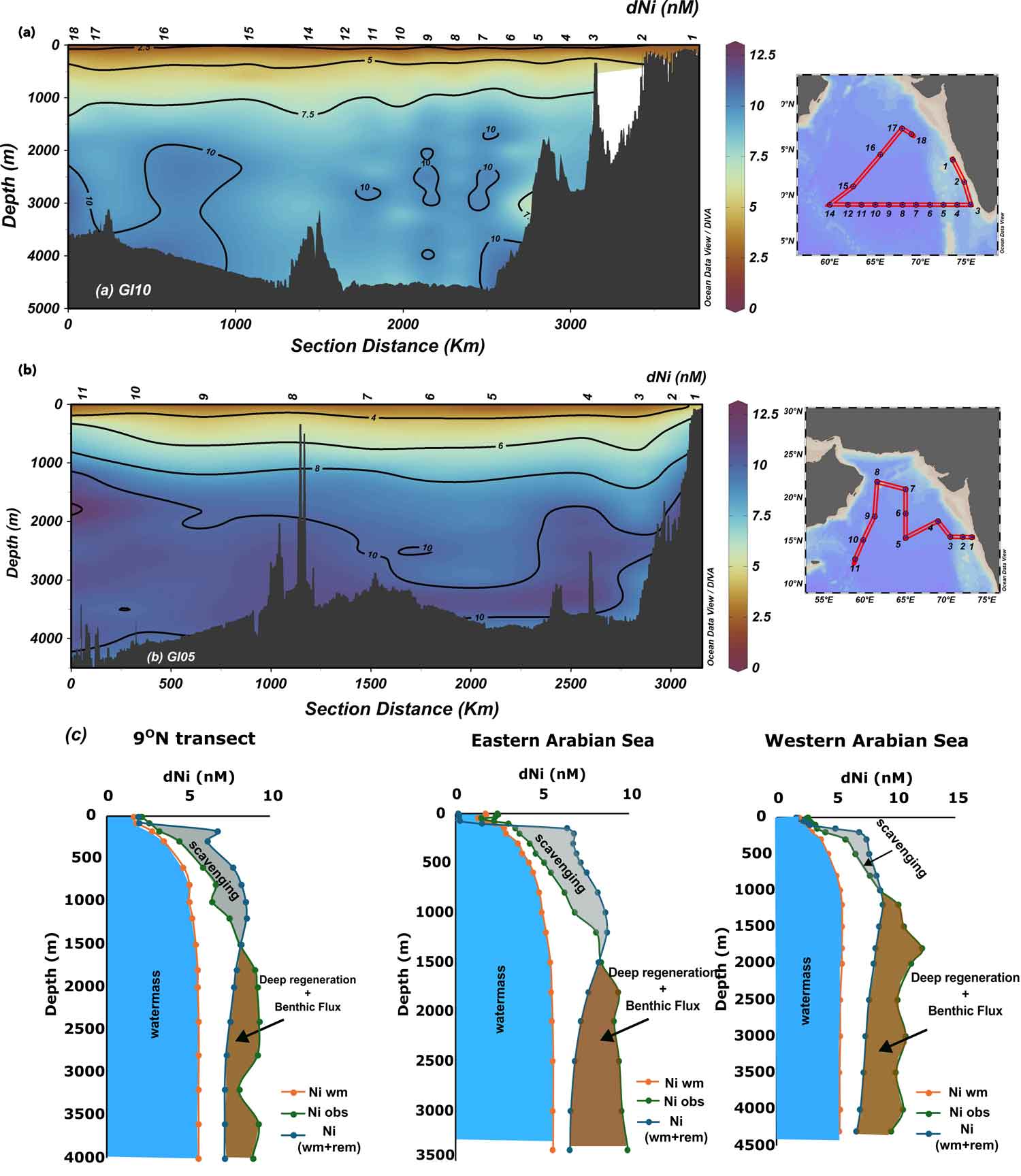
Figure: Section plots of dNi along the cruise track of (a) GI10 and (b) GI05 in the Arabian Sea. The cruise transects are given on the right side of the respective section plots. Please note the colour bar for the dNi concentration (nM). (c) Vertical plots showing the fraction of Ni contributed from the mixing of water masses (blue), inferred remineralised Ni and the observed dNi in the different regions of the Arabian Sea (9°N transect- GI10/10, Eastern Arabian Sea- GI10/17, Western Arabian Sea- GI05/11).  The difference in the observed Ni and (remineralised+ water mass) Ni suggests various processes like scavenging in the upper water column (1200-1500m) and regeneration (remineralisation and reversible scavenging) and/or benthic flux in the deeper waters (>1500m).

Reference:

Malla, N., Singh, S. K., Singh, N. D., Shukla, A., Chinni, V., Goswami, V., & John, R. (2025). The Role of Water Masses, Biological Processes, Remineralization and Reversible Scavenging in Controlling the Distribution of Dissolved Nickel in the Arabian Sea. Global Biogeochemical Cycles39. Access the paper:10.1029/2024gb008441

Latest highlights

Continuous record of the Antarctic Circumpolar Current latitude over the last glacial-interglacial cycles

The meridional positions of the oceanic fronts separating subtropical and Antarctic waters are key to constraining the mechanisms that drive the degassing of deeply-stored CO2 at the end of the glacial periods…

23 Million Years of iron sources reconstructed in the Northwest Pacific Ocean using iron isotopes in a ferromanganese crust

Using iron isotopes and elemental records, Chu and co-workers analysed an iron-manganese crust recovered from the Hongyan Seamount, and reconstructed the sources of dissolved Fe to the Northwest Pacific Ocean…

Variability of the past deep-water masses in the Arabian Sea over the last 41ka

Shukla and colleagues propose a high-resolution authigenic ƐNd record measured from a sediment core located in the eastern Arabian Sea…

Arctic outflows to Davis Strait and the Labrador Sea traced by radionuclide distributions

This study demonstrates that Arctic outflows through the Canadian Arctic Archipelago play a much more significant role than previously recognised.

Rechercher