
Comprehensive inverse model constrains the application of beryllium-7 as a deposition tracer
Measurements of beryllium-7(⁷Be) activity in surface waters provide a promising approach for quantifying the deposition of aerosol-bound elements at the ocean surface. In this application, it is generally assumed that (i) the fraction of marine ⁷Be in particulate form is negligible and/or (ii) the interactions between particulate and dissolved ⁷Be in seawater can be ignored. However, these assumptions have been questioned by the work of Grenier et al. (2023, see Science Highlight) based on samples collected along the GEOVIDE GA01 section.
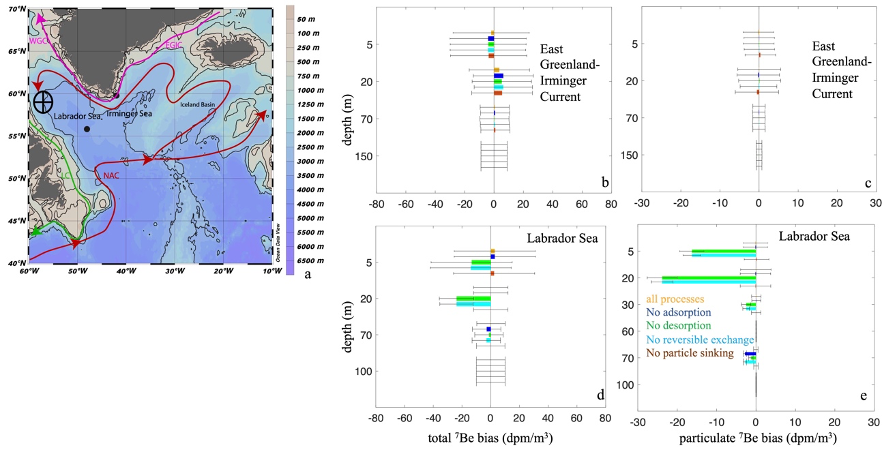
In the present study, Lerner and colleagues (2025, see reference below) test these assumptions using a comprehensive model that includes vertical advection, vertical diffusion, gravitational settling, radioactive decay, atmospheric deposition, and the reversible exchange between dissolved and particulate ⁷Be. By using an inverse method, they showed that their model can reproduce reasonably well the 7Be activity data collected at two stations of the GEOVIDE cruise (one station in the East Greenland-Irminger Current and the other in the southern Labrador Sea). However, while ⁷Be data from the East Greenland–Irminger Current can be reproduced without consideration of adsorption and/or desorption processes, reversible exchange or desorption needs to be considered in order to fit the ⁷Be profiles observed in the southern Labrador Sea. At the latter station, reversible exchange results in a significant imbalance between the surface deposition and water-column inventory of dissolved, but not total (dissolved + particulate), ⁷Be. Thus, the authors conclude that reversible exchange could be neglected when total ⁷Be, but not dissolved ⁷Be, is applied as a deposition tracer.
References:
Lerner, P., Grenier, M., Marchal, O., & van Beek, P. (2025). An inverse modelling approach to constrain 7Be cycling in the subpolar North Atlantic. Deep Sea Research Part I: Oceanographic Research Papers, 220, 104465. Access the paper: 10.1016/j.dsr.2025.104465
Grenier, M., van Beek, P., Lerner, P., Sanial, V., Souhaut, M., Lagarde, M., Marchal, O., & Reyss, J. L. (2023). New insights on the 7Be cycle in the ocean. Deep Sea Research Part I: Oceanographic Research Papers, 194, 103967. Access the paper: 10.1016/j.dsr.2023.103967