
Complex cobalt story in the Mediterranean Sea
Dulaquais and co-authors (2017, see reference below) propose the first comprehensive study of cobalt behaviour in the Mediterranean Sea, work conducted in the framework of MedBlack GEOTRACES cruise (GA04N). They measured the following cobalt (Co) fractions: soluble (sCo<0.02 μm), dissolved (DCo<0.2 μm), colloidal (cCo, as DCo minus sCo), and particulate (pCo>0.2 μm).
While soluble Co is the predominant form (90%) of the dissolved Co in the Mediterranean Sea, colloidal Co and particulate Co show a close distribution, yielding the authors to suspect a biogeochemical link between these two fractions.
More striking is the scavenged-like profile observed everywhere, with up to 350 nM dissolved Co concentrations in the surface waters dropping to 45 nM at depth. Such behaviour results from several mechanisms. High-surface Co inputs at Gibraltar Strait are horizontally transported by the Mediterranean circulation, surface dissolved Co is stabilized in a soluble form and biogenic particulate Co is very rapidly regenerated: all these processes concur to the accumulation of dissolved Co in the surface layers. Conversely, low particulate Co export, low remineralization of biogenic particulate Co at depth, and removal of dissolved Co by scavenging prevented its accumulation in the intermediate and deep sea.
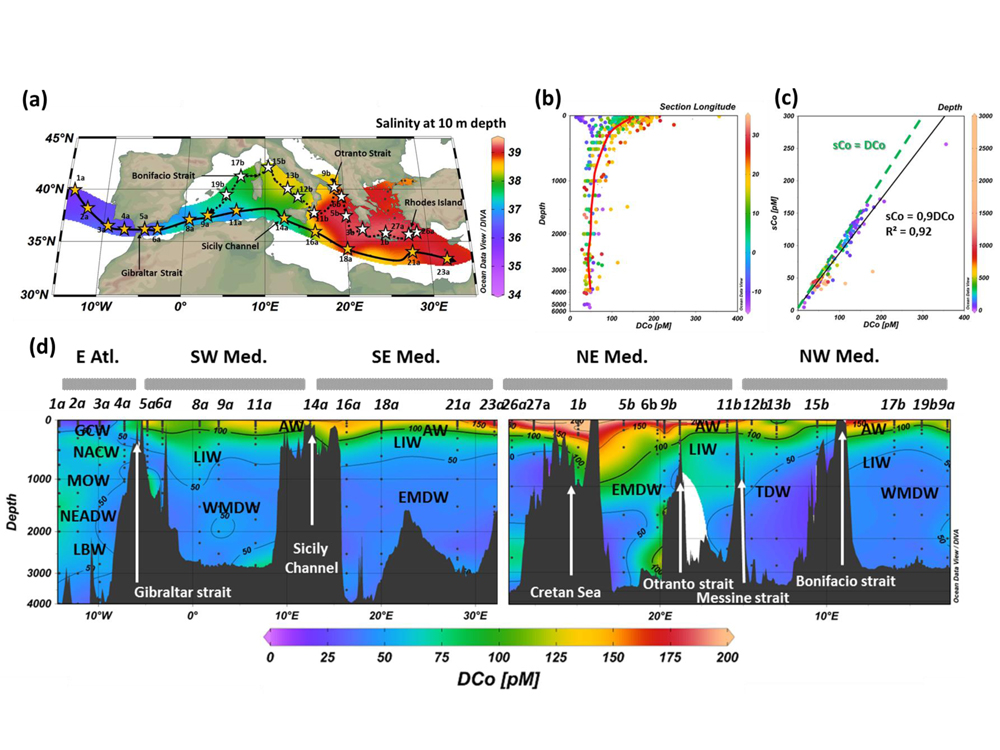
Figure: Distribution and partitioning of dissolved cobalt (DCo) in the Mediterranean Sea. We measured DCo along the GA04N section (a) and observed a scavenged like profile in all the different sub-basins of the Mediterranean Sea (b). In the Med, DCo was almost entirely composed of soluble cobalt (sCo) and colloids represented only 10% of the DCo pool (c). Resulting from high recycling rate and its stabilization under a soluble form, surface DCo concentrations increased eastward with ageing of surface waters (d). Differently accumulation of DCo by remineralization in the intermediate water was not discernable (d) and surprisingly the zonal distribution of DCo in the deep sea showed homogenous concentrations (d). We related these features to scavenging rates depth dependents and of different magnitude in the two Mediterranean basins as well as to the fast Mediterranean circulation that homogenize concentrations in the deep sea. Click here to view the figure larger.
Reference:
Dulaquais, G., Planquette, H., L’Helguen, S., Rijkenberg, M. J. A., & Boye, M. (2017). The biogeochemistry of cobalt in the Mediterranean Sea. Global Biogeochemical Cycles, 31(2), 377–399. DOI: 10.1002/2016GB005478