
Constraining aerosol deposition over the global ocean by the cosmogenic beryllium-7

He and co-workers (2025, see reference below) propose a global estimate of aerosol deposition onto the ocean using the cosmogenic radionuclide beryllium-7 (7Be). Despite their vital role in Earth’s climate system, aerosol deposition rates have been poorly constrained due to limited oceanic observations. The authors report new 7Be measurements from the GEOTRACES GP17-OCE and GS02 cruises, spanning the South Pacific, Southern Ocean and, Indian Oceans, and combined them with previously published 7Be data from other GEOTRACES expeditions. This integration of new and existing datasets enabled unprecedented spatial coverage across multiple ocean basins. Results reveal that global climate and chemical transport models systematically underestimate aerosol deposition by 39 ± 23%, leading to an overestimation of aerosol lifetimes in the marine atmosphere. This finding underscores the dominant role of precipitation-driven wet deposition and indicates that aerosols persist for shorter periods over oceans than previously thought. The new 7Be-based parameterization derived from this study provides a valuable observational benchmark for improving aerosol removal schemes in global models and for refining our understanding of aerosol-climate-ocean interactions. This work builds upon the pioneering legacy of the late Dr. David Kadko, whose foundational research in marine radioisotopes inspired and guided this study.
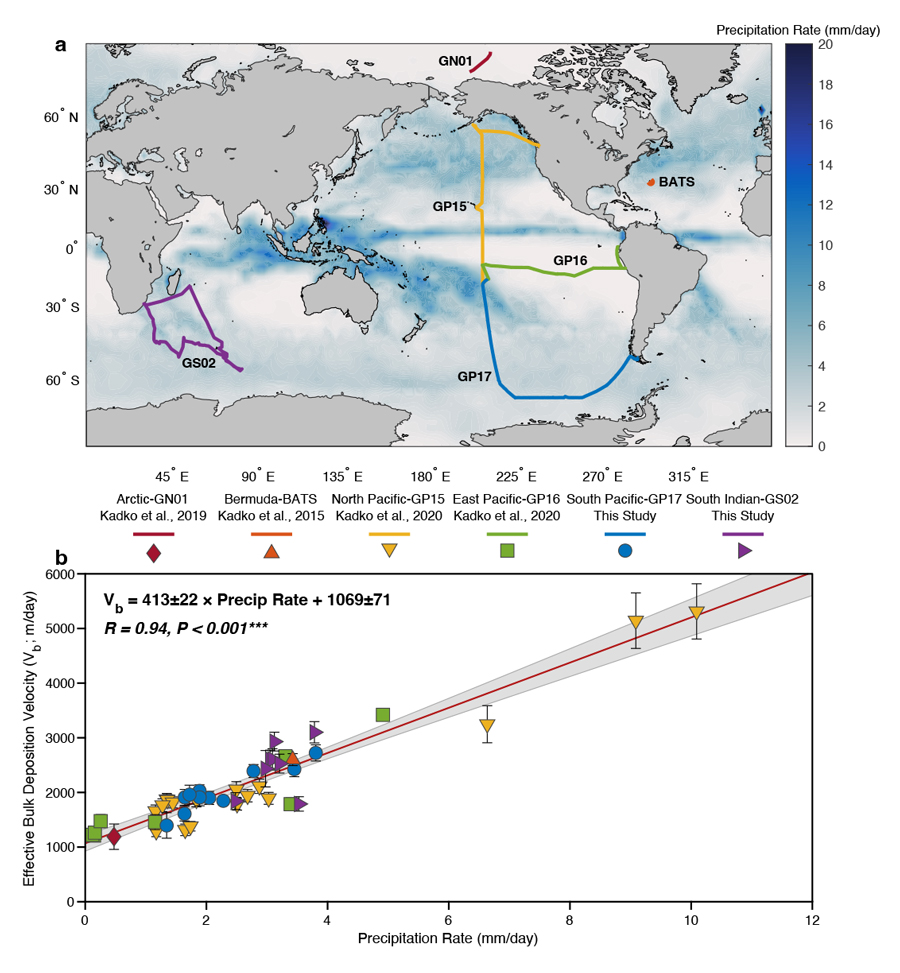
Figure: Measurements of 7Be inferred effective bulk aerosol deposition velocity and its linear correlation with precipitation rate. (a) Cruise tracks in the Arctic Ocean (red line), North Atlantic (orange line; BATS), North Pacific (yellow line), East Pacific (green line), South Pacific and Southern Ocean (blue line), and South Indian Ocean (purple line). (b) The linear correlation between effective bulk aerosol deposition velocity and precipitation rate. The intercept of the linear correlation implies, in the absence of precipitation, dry deposition velocity for the aerosol over ocean surfaces is 1069±71 m/day. Data are presented as mean values ± 1σ standard deviations.

Reference:

He, Y., Kadko, D.C., Stephens, M.P., Sheridan, M.T., Buck, C.S., Marsay, C.M., Landing, W.M., Zheng, M., Liu, P. (2025) Constraining aerosol deposition over the global ocean. Nature Geoscience. Access the paper: 10.1038/s41561-025-01785-2

Latest highlights

Continuous record of the Antarctic Circumpolar Current latitude over the last glacial-interglacial cycles

The meridional positions of the oceanic fronts separating subtropical and Antarctic waters are key to constraining the mechanisms that drive the degassing of deeply-stored CO2 at the end of the glacial periods…

23 Million Years of iron sources reconstructed in the Northwest Pacific Ocean using iron isotopes in a ferromanganese crust

Using iron isotopes and elemental records, Chu and co-workers analysed an iron-manganese crust recovered from the Hongyan Seamount, and reconstructed the sources of dissolved Fe to the Northwest Pacific Ocean…

Variability of the past deep-water masses in the Arabian Sea over the last 41ka

Shukla and colleagues propose a high-resolution authigenic ƐNd record measured from a sediment core located in the eastern Arabian Sea…

Arctic outflows to Davis Strait and the Labrador Sea traced by radionuclide distributions

This study demonstrates that Arctic outflows through the Canadian Arctic Archipelago play a much more significant role than previously recognised.

Rechercher