
Metal contents of North Atlantic phytoplankton across environmental gradients
Twining and co-workers (2015, see reference below) provide the first direct measurements of metal quotas in phytoplankton from across the North Atlantic Ocean (US GEOTRACES GA03), known to be subjected to aeolian Saharan inputs and anthropogenic inputs from North America and Europe.
The authors combine chemical leaches (to extract biogenic and otherwise labile partiulate phases) together with synchrotron X-ray fluorescence (SXRF) analyses of individual micro and nanophytoplankton to discern sptial trends across the basin. Among the numerous results of this study:
- Mean cellular metal quotas were similar to those measured in the Pacific and Southern Oceans except for iron (Fe), which was approximately 3-fold higher in North Atlantic cells.
- Cellular Fe quotas did not increase in step with aeolian dust inputs suggesting that the dust inputs have low bioavailability.
- Although particulate aluminium (Al) was primarily associated with lithogenic material, the labile Al fraction was highly correlated with phosphorus (P) and biogenic silica suggesting that perhaps 20% of particulate Al may be associated with biogenic material.
- Externally scavenged Fe was not a significant fraction of the metal associated with live phytoplankton, in contrast to the importance of adsorbed or precipitated phases on detrital material.
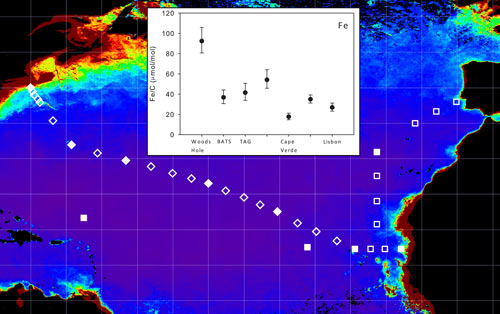
Figure: Map of stations sampled during GEOTRACES cruise GA03 plotted over MODIS surface chlorophyll for November and December (2010-2011). Stations with SXRF samples are shown with filled symbols. Cellular iron quotas measured for cells at these stations are shown in the overlaid figure. Phytoplankton in the western part of the transect contain approximately four-fold more Fe than cells in the eastern part of the transect. Click here to view the figure larger.
Reference:
Twining, B. S., Rauschenberg, S., Morton, P. L., & Vogt, S. (2015). Metal contents of phytoplankton and labile particulate material in the North Atlantic Ocean. Progress in Oceanography, 137, 261–283. doi:10.1016/j.pocean.2015.07.001. Click here to access the paper.