
Dissolved gallium unravels Pacific and Atlantic waters in the Arctic Ocean

In the Arctic Ocean, the relative amounts of Pacific and North Atlantic-derived water affect its heat and salt balance which, in turn, affects climate-relevant processes such as the formation of of Arctic sea ice. Previous attempts to deconvolve these sources have utilized nutrient-based tracers which have been unsatisfying because the nutrients are non-conservative in ways that are difficult to compensate for.

Whitmore and co-workers (2020, see reference below) demonstrate that the dissolved gallium (Ga) distribution is conservative enough in the Arctic to provide a better water source deconvolution than the nutrient tracers.

Indeed, dissolved Ga concentrations show measurable contrast between Atlantic and Pacific source waters, shelf‐influenced waters show little impact of shelf processes on the dissolved Ga distribution, and dissolved Ga in the Arctic basins is conserved along isopycnal surfaces. Among others, the authors reveal that use of Ga as tracer yields a more realistic vertical transition between Pacific and Atlantic waters than the nutrient method with the result that there appears to be more Pacific sourced water than previously estimated.
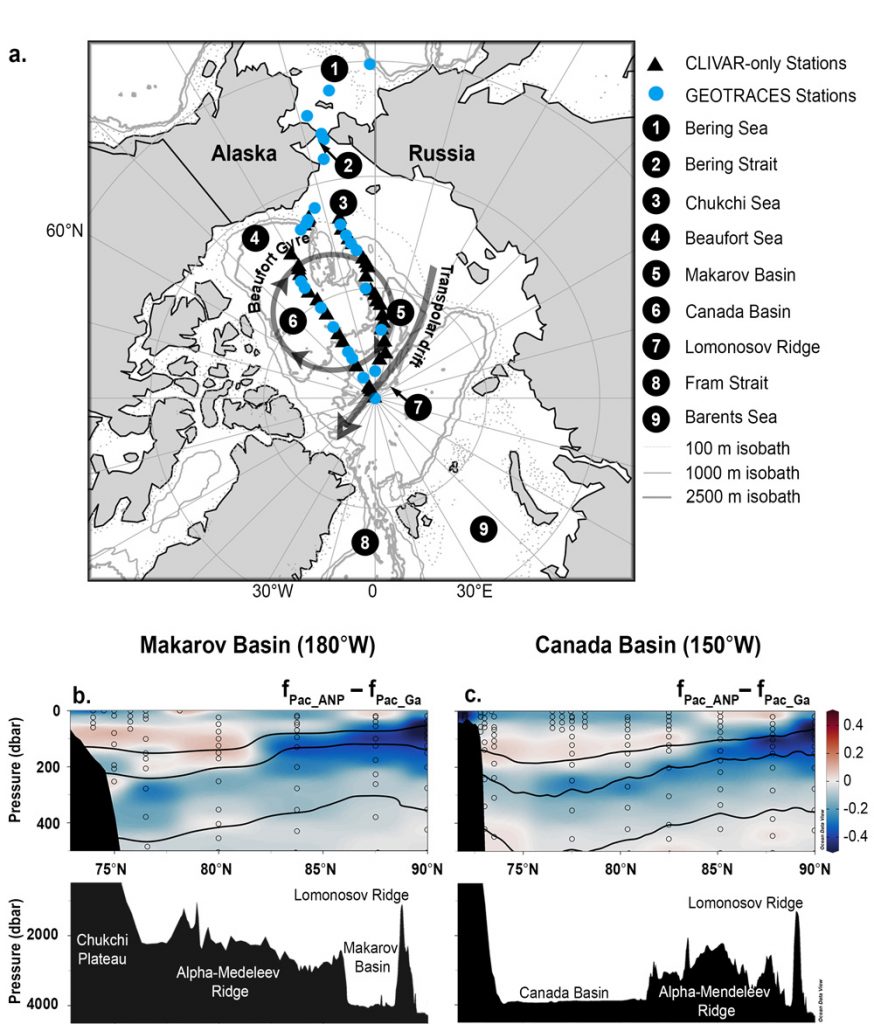
Figures: a) Station map for 2015 US GEOTRACES Arctic section (GN01). Also shown are notable geographic features and major flow paths of shallow waters in the western Arctic. b) & c) Transects from the Chukchi Sea to the North Pole showing differences between previous nutrient method and the new gallium method in predicting the fraction of Pacific Ocean-derived seawater in the western Arctic Ocean. Blue colors indicate regions where the nutrient method predicts less Pacific water than the gallium method; red regions indicate the opposite.

Reference:

Whitmore, L. M., Pasqualini, A., Newton, R., & Shiller, A. M. (2020). Gallium: A New Tracer of Pacific Water in the Arctic Ocean. Journal of Geophysical Research: Oceans, 125(7). DOI: https://doi.org/10.1029/2019JC015842

Latest highlights

Zinc and lead isotopes reveal human footprint on the most remote oceanic regions

Benaltabet and co-workers analysed suspended particles collected on GEOTRACES GP21 cruise tracked from Chile to New Caledonia.

Organic binding site heterogeneity controls amorphous ferric oxy-hydroxides oceanic sink

In oxygenated seawater iron binds to hydroxide ions, which results in authigenic Fe precipitation as amorphous ferric oxy-hydroxide…

Microbial trace metal transport in distinct water masses of the Southern Indian Ocean

Zhang and colleagues used genes coding for membrane transporters as proxies to map the distribution of the uptake and efflux of the trace metals…

Contraction of North Atlantic Deep Water during glacial times: a paradigm called into question

Blaser and co-authors propose a new distribution of deep-water masses in the Atlantic Ocean during the Last Glacial Maximum and the Heinrich Stadial 1…

Rechercher