
Shallow methylmercury production in the marginal sea ice zone of the central Arctic Ocean
Understanding persistent high levels of mercury in arctic biota has been an elusive goal for nearly two decades. Little is known about where exactly inorganic Hg inputs into the Arctic generate the toxic methylmercury (MeHg) form that bioaccumulates in biota. Lars-Eric Heimbürger and colleagues (2015, see reference below) present the first full-depth high resolution profiles (> 5200 m-depth) of total mercury (tHg) and MeHg in the central Arctic Ocean (79-90°N). MeHg maxima occur in the pycnocline waters, although noticeably shallower than in the other oceans (150 m in the Arctic versus roughly 1000 m in the Atlantic). These shallow maxima are probably due to the accumulation of settling biogenic particles slowed down by the strong density barrier of the arctic pycnocline, which in turn will favor their microbial degradation and MeHg production. The shallow MeHg maxima likely result in enhanced biological uptake at the base of the marine food web, yielding elevated MeHg levels in Arctic wildlife. For this study the authors developed a new double isotope-dilution MeHg detection method with exceptional precision and low detection limit. These new findings will be guide future Arctic Hg research, notably the international Arctic GEOTRACES multi-ship survey planned for summer 2015 by American, Canadian and German teams.
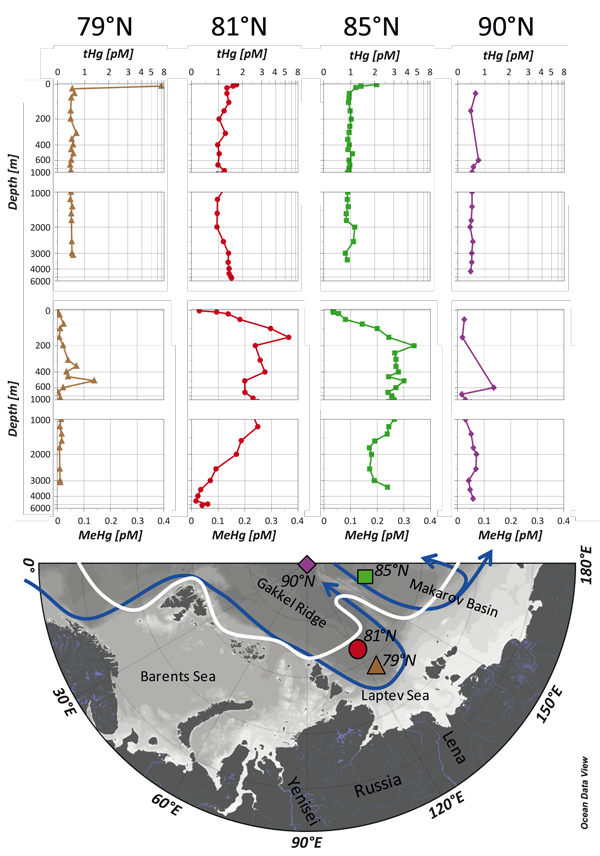
Figure: Total mercury (tHg) and methylmercury (MeHg) profiles in picomoles per litre (pM) at the coastal influenced open water Laptev Sea station (PS78/280:79°N; brown triangles), the open water Amundsen Basin station at the sea ice edge (PS78/273:81°N; red dots), the > 75% sea ice covered Makarov Basin station (PS78/245:85°N; green squares), and the permanently sea ice-covered North Pole station (PS78/218:90°N, purple diamonds). The white line indicates the sea ice extent during the time of sampling. The blue line shows the general oceanic circulation of intermediate and Atlantic waters after Rudels, 2012. Click here to view the figure larger.
References:
Heimbürger, L.-E., Sonke, J. E., Cossa, D., Point, D., Lagane, C., Laffont, L., Galfond, B.T., Nicolaus, M., Rabe, B., van der Loeff, M. R. (2015). Shallow methylmercury production in the marginal sea ice zone of the central Arctic Ocean. Sci. Rep., 5. DOI: 10.1038/srep10318. Click here to access the paper.
Rudels, B. Arctic Ocean circulation and variability – advection and external forcing encounter constraints and local processes. Ocean. Sci. 8 261–286 (2012).