
A geochemical-physical coupled approach to study phytoplankton plume dynamics off the Crozet Islands (Southern Ocean)
Interaction of the currents with the sediments deposited on the margins of the Crozet Islands (Southern Ocean) contributes to the supply of iron and other micronutrients to marine waters. This natural fertilization feeds a phytoplankton bloom that was object of study of the KEOPS 2 GEOTRACES process study.
Sanial and co-authors (2014, see reference below) combined three independent methods – including geochemical and physical methods. This allowed them to assess the origin of the natural iron fertilization and the rates and times scale of the offshore transport in the phytoplankton bloom of Crozet. Shelf-water contact ages were determined using radium isotopes and were compared to in situ drifter data and modeling data based on altimetry.
This work highlights the key role played by the horizontal transport in the natural iron fertilization and provides constraints on the transit time of surface waters between the shelf and offshore waters.
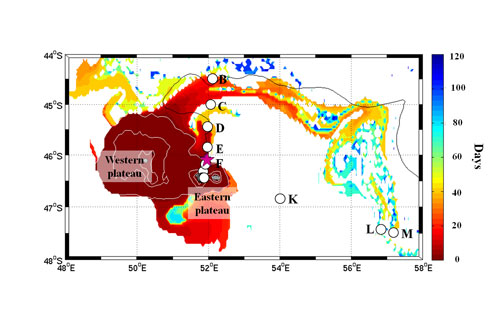 Figure: Ages of surface waters derived from a Lagrangian model based on altimetry data. The drifter launched offshore Crozet Islands followed the numerical plume deduced from the model. White circles show the location of radium samples. Please click here to view the figure larger.
Reference:
Sanial, V., van Beek, P., Lansard, B., D’Ovidio, F., Kestenare, E., Souhaut, M., Zhou, M., Blain, S. (2014). Study of the phytoplankton plume dynamics off the Crozet Islands (Southern Ocean): A geochemical-physical coupled approach. Journal of Geophysical Research: Oceans, 119(4), 2227–2237. doi:10.1002/2013JC009305. Click here to access the paper.