
Neodymium budget in the Arabian Sea is governed by a combination of water mass advection and dominant boundary exchange processes

Karri and Singh (2026, see reference below) established the neodymium (Nd) concentrations and isotopic compositions -expressed as εNd- along a North-South section in the eastern Arabian Sea. The horizontal and vertical distributions of both dissolved Nd parameters underscore the influence of multiple sources and water masses, reflecting the complexity of the local hydrographic setting. Non-radiogenic Nd reflects the release of Nd from particles delivered by the Indus River in the northern Arabian Sea, and by the Ganga-Brahmaputra and peninsular rivers in the south-eastern region. In contrast, atmospheric mineral dust deposition from adjacent landmasses imprints radiogenic Nd signatures in the surface waters of the central Arabian Sea. Using an inverse model-derived excess Nd in surface waters, the authors estimate a dust flux of 1.8 ±1.4 g m−2 y−1 over the Arabian Sea.
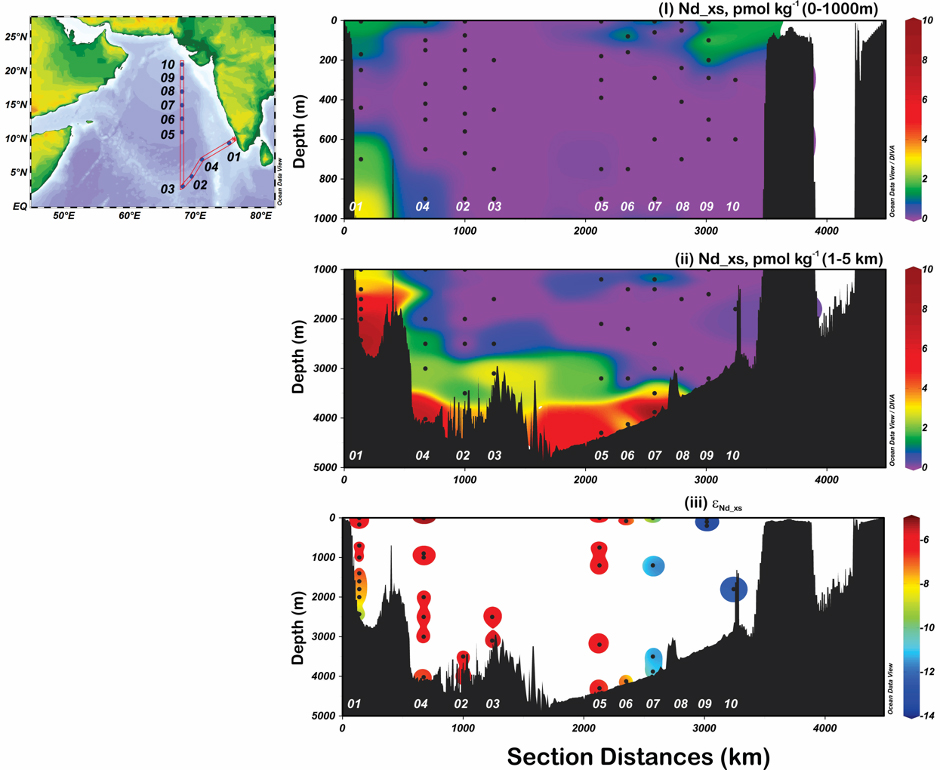
Figure: Samples were collected along the cruise track (shown in the left panel) in the Arabian Sea during pre-monsoon (April–May) 2012 for Nd concentration and its isotope analyses. Nd isotope composition of the Arabian Sea is defined by the mixing of various water masses present in the basin and the addition of extra Nd derived from the atmospheric dust being deposited in the central Arabian Sea and sediments being transported from the Indus in the northern Arabian Sea and from the Bay of Bengal to the Arabian Sea, particularly in the southeastern Arabian Sea.

Reference:

Karri, D., & Singh, S. K. (2026). Control of the water masses, aeolian and fluvial particulates and deoxygenation on the dissolved neodymium and its isotope composition in the Arabian Sea. Chemical Geology, 719, 123571. doi:10.1016/j.chemgeo.2026.123571

Latest highlights

Another step towards replacing NOBIAS Chelate PA-1

Kanna and his colleagues successfully carried out the quantitative pre-concentration of seven trace metals…

Cesium isotopes confirm that hydrogenetic iron-manganese crusts are precipitating from the oxygen minimum zone to abyssal depths

Li and co-authors provide new insights on the formation mechanism of ferromanganese crusts.

Continuous record of the Antarctic Circumpolar Current latitude over the last glacial-interglacial cycles

The meridional positions of the oceanic fronts separating subtropical and Antarctic waters are key to constraining the mechanisms that drive the degassing of deeply-stored CO2 at the end of the glacial periods…

23 Million Years of iron sources reconstructed in the Northwest Pacific Ocean using iron isotopes in a ferromanganese crust

Using iron isotopes and elemental records, Chu and co-workers analysed an iron-manganese crust recovered from the Hongyan Seamount, and reconstructed the sources of dissolved Fe to the Northwest Pacific Ocean…

Rechercher