
Variability of the past deep-water masses in the Arabian Sea over the last 41ka
Shukla and colleagues (2026, see reference below) propose a high-resolution (∼400-year) authigenic ƐNd record measured from a sediment core (hereafter referred to as GC10; 2,055 m water depth) located in the eastern Arabian Sea. They demonstrate that variations in the ƐNd record in this area resulted from changes in the relative proportions of southern-sourced deep-water masses, with Antarctic Bottom Water (AABW) dominating during colder periods and North Atlantic Deep Water (NADW) during warmer periods. On millennial timescales, the same balance between NADW and AABW is observed: whereas the Last Glacial Maximum and Heinrich events are characterized by greater intrusion of AABW, rapid warm climate events show a predominance of NADW. Through analysis of the Nd signature in the lithogenic material, the authors also detect a significant Ganga–Brahmaputra influence between 28 and 18 ka, likely related to an intensified northeast monsoon period.
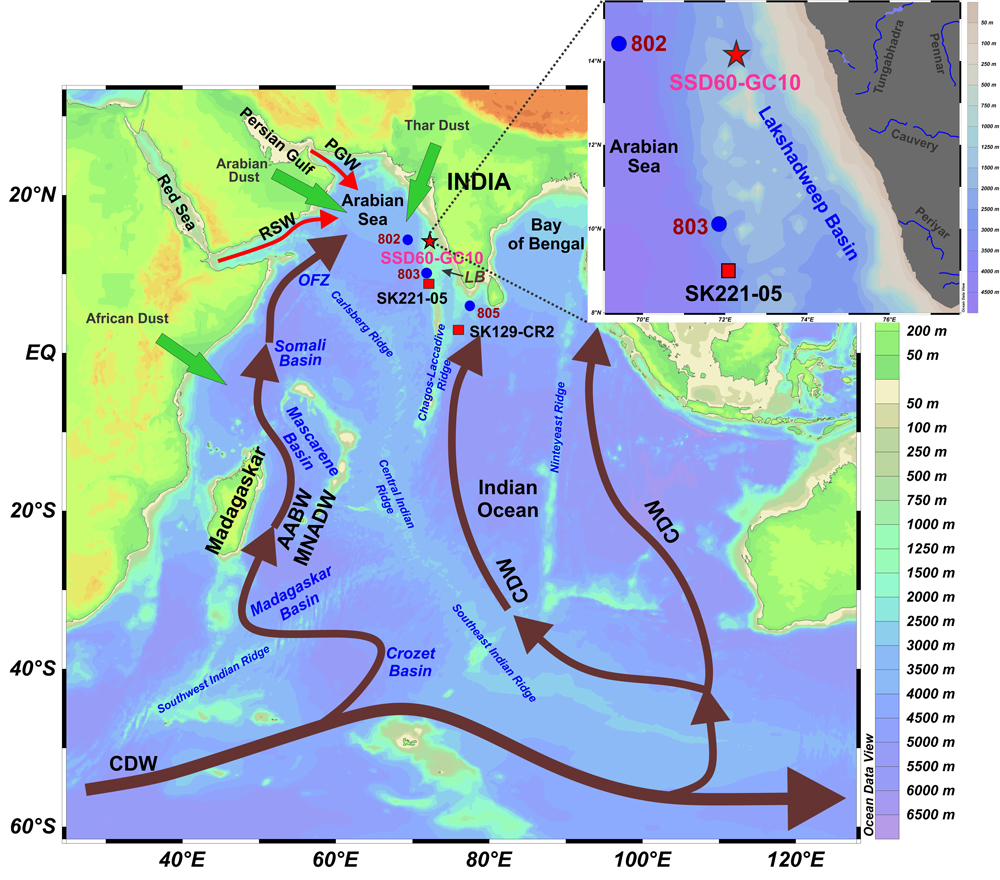
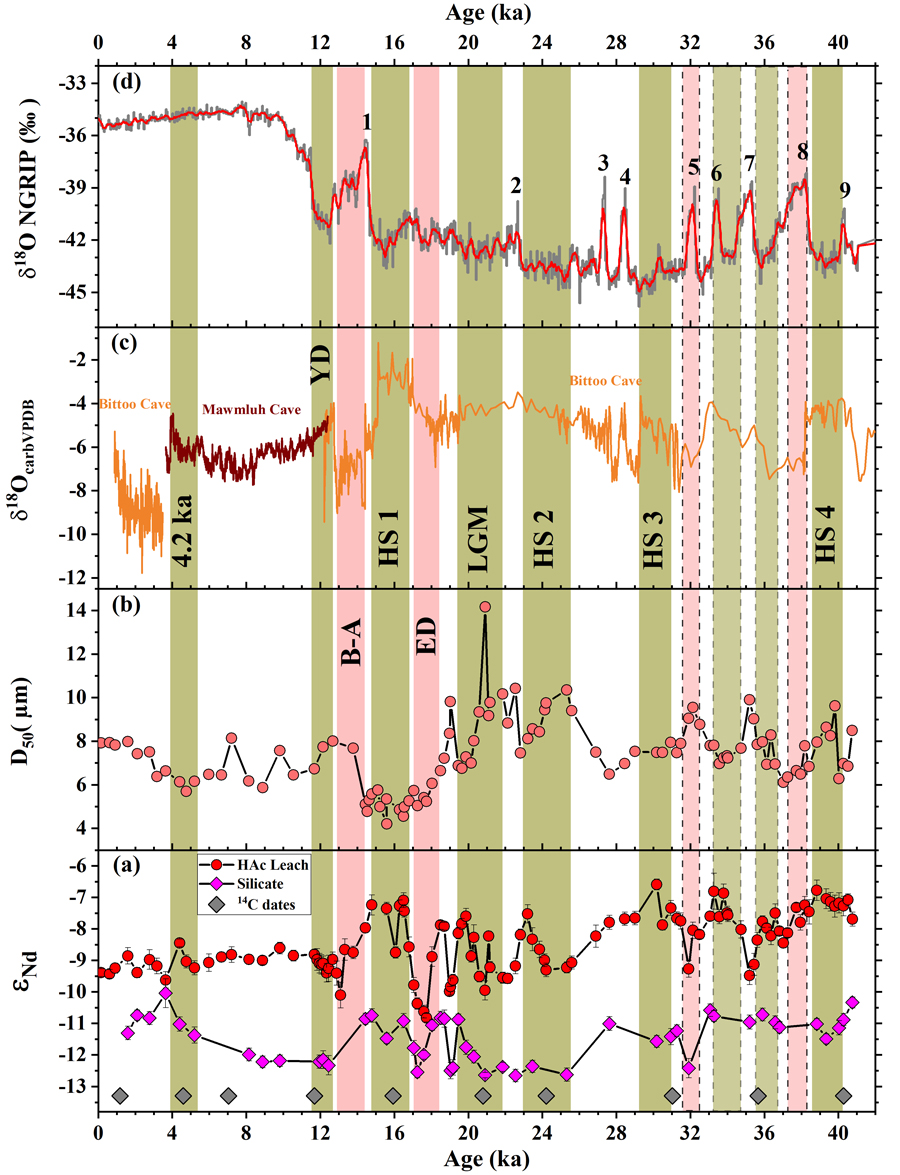
Figure: Temporal variation of authigenic (HAc leachates) and detrital ƐNd values (a) and median grain size (D50) (b) of the present study compared with δ18OcarbVPDB (Oxygen isotope measured in the Carbonate and expressed relative to Vienna PeeDee Belemnite) (c) and, δ18O of NGRIP ice core (d), marked with the cold and warm climatic events/periods. Numbers indicate the Dansgaard‐Oeschger interstadials. The red color line shows the 5‐point moving average of δ18O of the NGRIP core. Radiocarbon (14C) dates of the GC10 core are marked on the X‐axis with gray diamonds.
Reference:
Shukla, A., Mishra, T. K., & Singh, S. K. (2026). Tracking the Millennial Scale Variability of Deep Water Circulation and Lithogenic Influence in the Arabian Sea Over the Past 41 ka Through Nd Isotope. Paleoceanography and Paleoclimatology, 41. Access the paper:10.1029/2025pa005310