
When ocean dynamic drives the land to ocean input of iron
Nishioka and co-authors demonstrate the pivotal role of tidal mixing in the Kuril Islands chain (KIC) for determining iron (Fe) supply to the euphotic zone of the Western Subartic Pacific. Indeed, Fe derived from sediments in the Sea of Okhotsk is discharged through the KIC into the intermediate water masses (~ 800 m) of the western North Pacific. The redistribution of this Fe-rich intermediate water by intensive mixing as it crosses the KIC is the predominant process determining the ratio of micronutrient (Fe) to macronutrients (e.g., nitrate) in subsurface waters. This process explains the significant phytoplankton growth and great seasonal variability observed in the Western compared to the Eastern Subarctic Pacific.
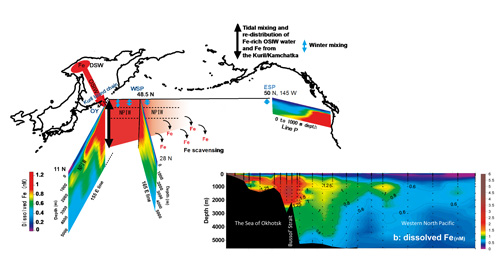
Figure: This image shows the role of tidal mixing in the oceanic dissolved Fe cycle in the subarctic North Pacific, with section profiles of dissolved Fe from this Nishioka’s work and from previous Nishioka’s works (Line P and 165°E line [Nishioka et al., 2001, 2007]).
A basin-scale vertical section profiles for disolved Fe is also shown on the bottom right corner of the figure.Please click here to see the figure larger.
References:
Nishioka, J., T. Nakatsuka, Y.W. Watanabe, I. Yasuda, K. Kuma, H. Ogawa, et al. (2013) Intensive mixing along an island chain controls oceanic biogeochemical cycles Global Biogeochemical Cycles, Volume: 27, Issue: 3 DOI: http://dx.doi.org/10.1002/gbc.20088
Nishioka, J., S. Takeda, C. S. Wong, and W. K. Johnson (2001), Sizefractionated iron concentrations in the northeast Pacific Ocean: Distribution of soluble and small colloidal iron, Mar. Chem., 74, 157–179.
Nishioka, J., et al. (2007), Iron supply to the western subarctic Pacific: Importance of iron export from the Sea of Okhotsk, J. Geophys. Res.,112, C10012, DOI: htttp://dx.doi.org/10.1029/2006JC004055.