
Assessment of the Solomon Sea’s dissolved iron contribution to the Equatorial Under Current
The Solomon Sea is a semi-enclosed sea in the southwestern Pacific, characterized by complex topography, narrow straits, and highly dynamic circulation. Concentrations of biolimiting trace metals in the water masses transiting through the Solomon Sea are expected to change due to strong western boundary currents and turbulent mixing interacting with the surrounding islands. Since water exiting the Solomon Sea partly feeds the Equatorial Under Current (EUC), understanding this process is important.
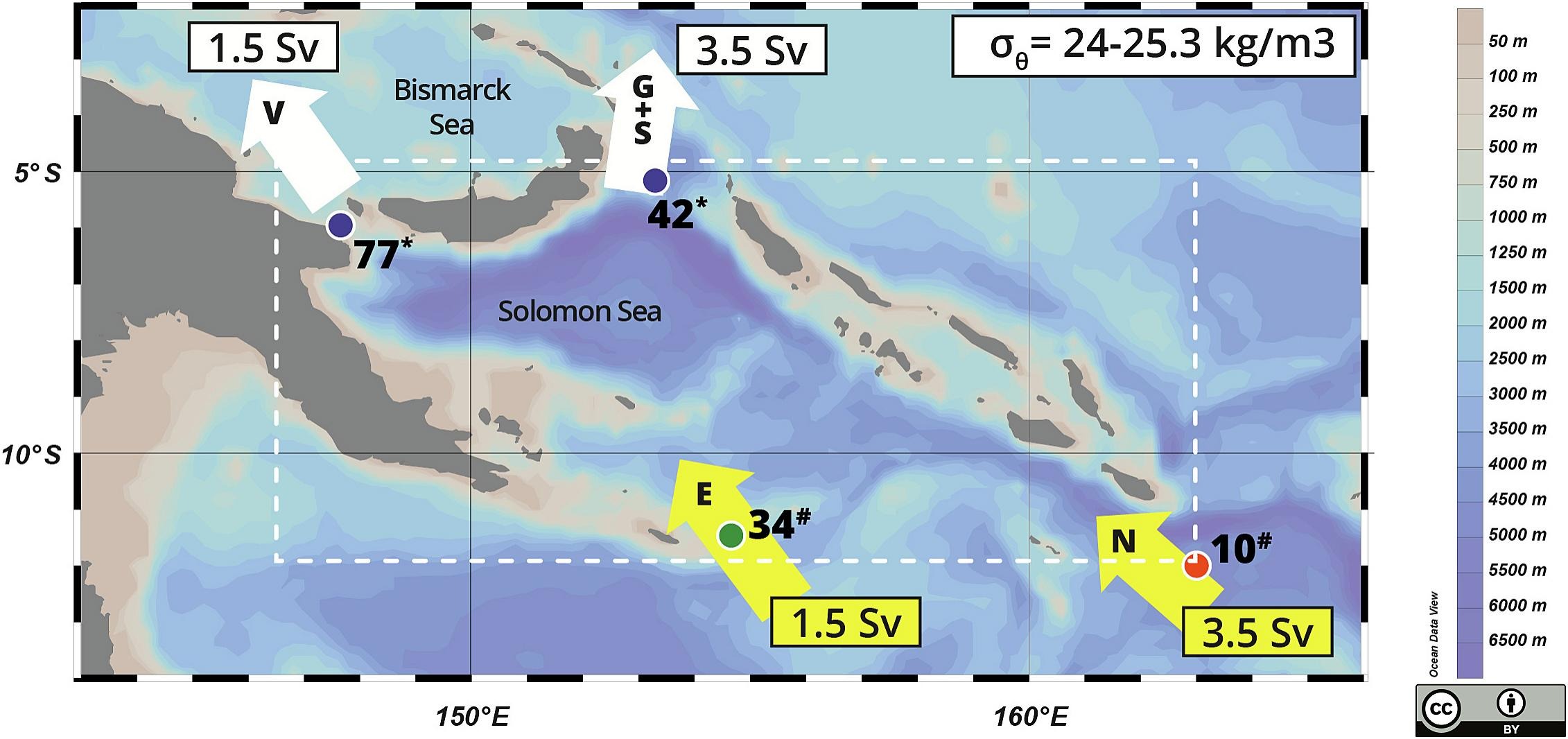
As part of the PANDORA cruise (GEOTRACES GP12), Sarthou and co-workers (2025, see reference below) analysed 11 vertical profiles of dissolved iron (dFe) at the entrance, within, and at the exit of the Solomon Sea. They found that:
- The amount of dFe enrichment within the enclosed sea was not significant in the lower thermocline and intermediate waters.
- In contrast, dFe enrichment was significant in the upper thermocline layer and deep waters, reflecting contributions from external sources as well as internal processes such as scavenging and/or organic complexation.
Overall, the relative dFe contribution of the Solomon Sea to the EUC was approximately 20%. This indicates that EUC iron enrichment also derives from other external sources, as previously discussed for rare earth elements and neodymium isotopic composition by Pham et al. (2019, see science highlight here).
Reference:
Sarthou, G., Bucciarelli, E., Quéroué, F., Lacan, F., Planquette, H., Pham, V. Q., Grand, M., Pradoux, C., Rodier, M., Bonnet, S., Eldin, G., Cravatte, S., Jeandel, C., & Ganachaud, A. (2025). Dissolved iron distribution and budget in the Solomon Sea. Marine Chemistry, 273, 104567. Access the paper: 10.1016/j.marchem.2025.104567
Pham, V. Q., Grenier, M., Cravatte, S., Michael, S., Jacquet, S., Belhadj, M., Nachez, Y., Germineaud, C., Jeandel, C. (2019). Dissolved rare earth elements distribution in the Solomon Sea. Chemical Geology, 524, 11–36. Access the paper: https://doi.org/10.1016/J.CHEMGEO.2019.05.012