
Trace metal effluxes from Peruvian shelf sediments

Shelf sediments are a major reservoir of labile trace metals. For dissolved redox sensitive elements such as iron (Fe), shelf sediments underneath oxygen minimum zones are typically a major source to the water column. However, quantifying the associated dissolved fluxes is methodologically challenging. Liu and colleagues (2025, see reference below), compare four different methods for estimating the Fe flux from Peruvian shelf sediments and show that the results are quite variable. Estimates of benthic Fe release suggest Fe residence times in the water column from 5 days to 7 years for the Peruvian shelf depending on exactly what spatial scale the benthic efflux is constrained over. This largely reflects the strong attenuation of dissolved Fe efflux from shelf sediments on spatial scales of 0.1-10 m from the seafloor.
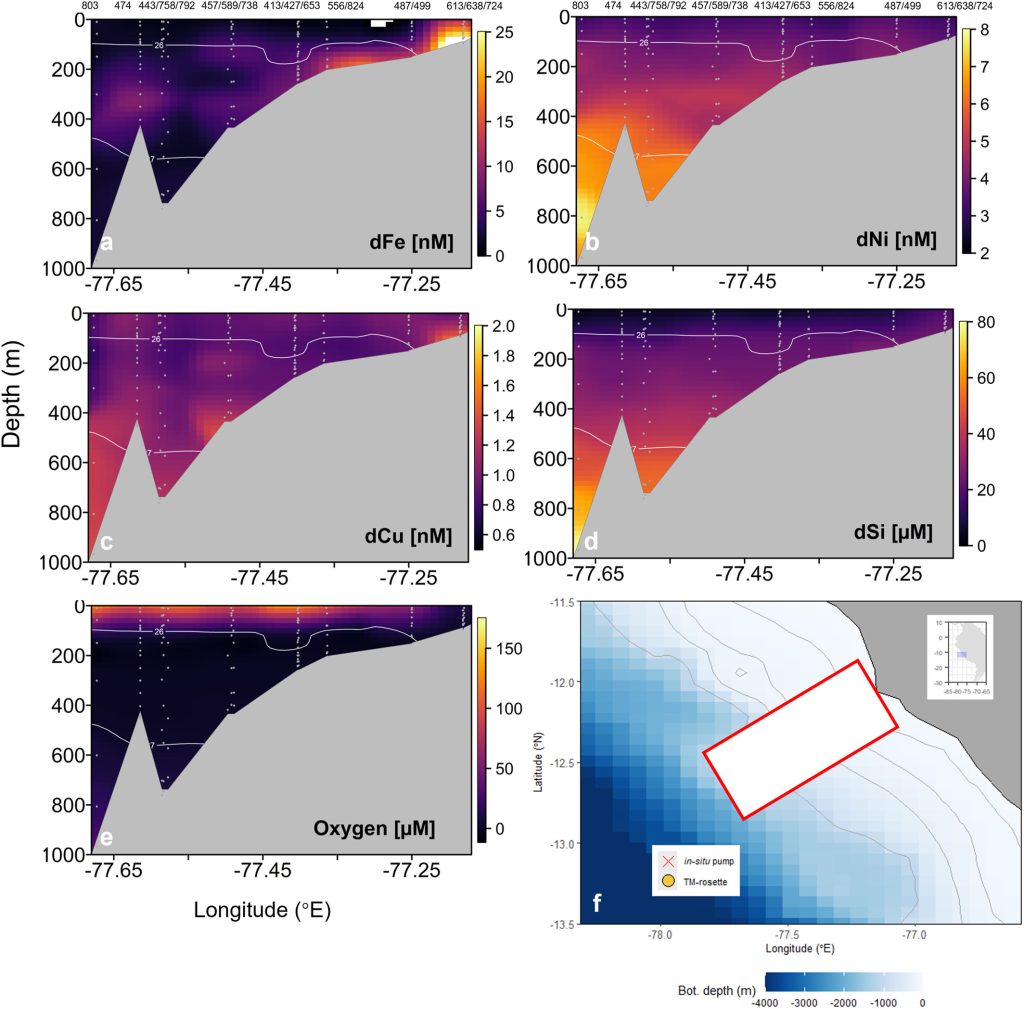
Figure: Dissolved iron, nickel, copper, silicon, and oxygen along a transect across the Peruvian shelf at 12°S. The data were collected using the TM-rosette system during two research cruises, M136 and M137.

Reference:

Liu, T., Plass, A., Gledhill, M., Scholz, F., Achterberg, E. P., & Hopwood, M. J. (2025). Trace Metal Effluxes From Peruvian Shelf Sediments Constrained in Parallel by Benthic Lander Mounted Pumps and Pelagic Rosette Sampling. Journal of Geophysical Research: Biogeosciences, 130. Access the paper: 10.1029/2024jg008583

Latest highlights

Contrasting organic carbon  remineralisation rates revealed by particulate excess barium in the North Pacific and South China Sea

Yuan and co-workers quantify organic carbon remineralisation in the twilight zone of the China Sea using particulate excess barium as a proxy…

Sedimentary controls on seawater nickel distributions and nickel isotope compositions: a two steps study

Nickel isotopic mass balance in the ocean stands among the less understood so far…

23 million years of productivity reconstructed in the Central Pacific Ocean using past and modern proxies

Using diverse geochemical proxies, Chu and colleagues analysed an iron–manganese crust to reconstruct central Pacific productivity over the past 23 million years.

Lead isotopes reveal that hydrothermal variability is driven by Sea‐Level change and transient magmatism

De and colleagues present the first millennial-scale reconstruction of hydrothermal variability at a mid-ocean ridge using lead isotopes from iron-manganese coatings…

Rechercher